
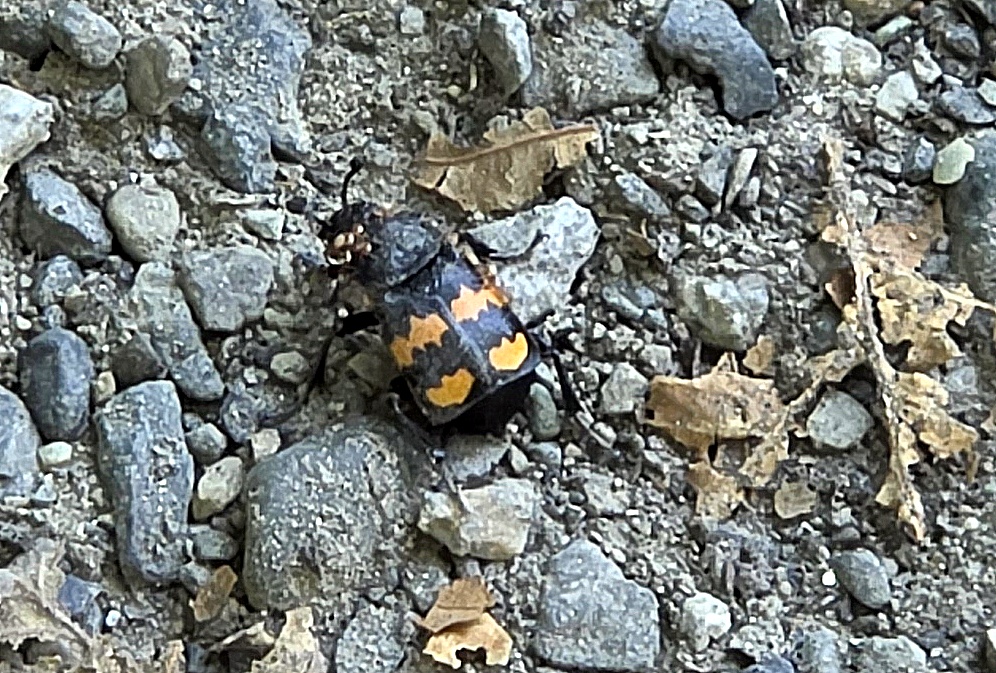
PHOTO: Burying Beetle with phoretic mites by Teresa Jones…….

Seven Delta Nats met in Campbell Valley Regional Park on a cool, beautiful August morning– Dottie, Bob, Dawne, Lee, Lindly, Lorna and Teresa. Directionally challenged, we headed up the main trail, doing the usual route in reverse. Seen were Red-Breasted Nuthatches, Towhees, Dark-eyed Juncos, Black-capped Chickadees, a Song Sparrow, and Pine Siskins. Heard were Western Flycatcher, Chestnut-backed Chickadee, Golden-crowned Kinglet and Northern Yellow Warbler. We stopped by the second bridge to see if the Grosbeaks were still around. We didn’t see or hear them, but did add an Anna’s Hummingbird, Hermit Thrush, Willow Flycatcher and Teresa heard Purple Martins (confirmed by Merlin).
Continuing on up towards the pond, Lindly’s sharp eyes found a Burying Beetle on the path (genus Nicrophorus). Burying Beetles get their name because they literally bury the dead bodies of small animals like mice and birds underground. They use the hidden carcasses as a safe food supply for their future babies. They are also called sexton beetles after church gravediggers. These fascinating, (if somewhat gruesome), dark beetles with W-shaped orange wing patches are attracted to the corpses of small rodents or birds by the smell. Males fight males and females fight females to become a mating pair that will jointly own the corpse. Victorious male and female carry the corpse to their den, sometimes lying on their backs and using their upraised legs to pass it along overhead. From this point it gets a little too grim for a birding blog, but it was noted online that they usually carry many small mites, who ride along in order to feed off botfly eggs found on the carcass. Sure enough, when we looked closely we could easily see the mites moving over the head and abdomen of the beetle. Phoresy is a specialized hitchhiking behavior where tiny mites use beetles as transport to move from one food source or habitat to another. The mites do not feed on the live beetle; instead, they save energy and travel safely until the beetle reaches a resource like dung or a carcass. The adult beetles are unharmed by the presence of the hitchhikers. The mites disembark at the food source and eat fly eggs or competing fly larvae, helping the beetle offspring survive.
We continued on to the pond, where the water level was about half as high as usual. There we found a garter snake as well as the usual Bullfrogs. It was quiet, bird-wise, with a Steller’s Jay, Robin and Song Sparrow. Lee checked out an insect collecting device that was set up for a study.
Heading back, we found a Downy Woodpecker in an elderberry bush eating berries, then we crossed over the bridge and walked up to the meadows a ways, adding Goldfinches and Cedar Waxwings. By this point the day was heating up. We headed back to the cars grateful not only for the shade of the big trees, but also the calls of a Swainson’s Thrush, and a morning spent in good company.
Report by Dottie Uhlman
Photos are on flickr
Next Tuesday & Wednesday (August 25 & 26) the outings will be to Centennial Beach in Tsawwassen.
Meet at 8 AM in the concession/washroom parking lot.
To sign up for an outing, click on the DNS bird outing schedule sheet.