
The Life of a Beach Grove Garter Snake
At the March 5, 2024 DNS meeting, member Carmen Prang, our “snake sitter” did a short presentation on the garter snakes at our local hibernaculum.
Carmen spent many hours in the area of the hibernaculum, trying to keep people and dogs from disturbing the snakes, taking note of traffic on the dyke path – pedestrians, dogs, bicycles, e-bikes and horses. She handed out about a hundred of our DNS Garter Snakes in Boundary Bay pamphlets (click on link to see the pamphlet) and talked with many passers-by about the snakes.
After spending significant hours at the Beach Grove Hibernaculum last Spring and Fall, I gained some insight into this.
I was there for extended periods of time, which was necessary to get a real picture of what happens there. With the hibernaculum area right next to the Boundary Bay Dyke Trail and the ocean on the other side, I was never bored no matter the weather.

I quickly noticed that people, sometimes with dogs and children, dismiss the sign messages to give the snakes “space and distance”. It surprised me how busy the dyke trail has become. Local schools held running events on the trail. The elementary school was often there for playtime during the last hour of the school day. More people on the trail meant more disruption to the snakes peaceful basking during the afternoon hours.
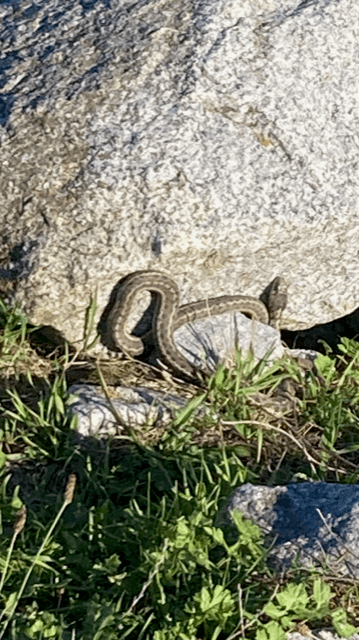
Like us, the snakes want to be out when it’s warmest and it’s also when the sun shines onto the front of the rocks, perfect for basking. As the weather warms, the snakes get stronger and move quicker around the rocks.
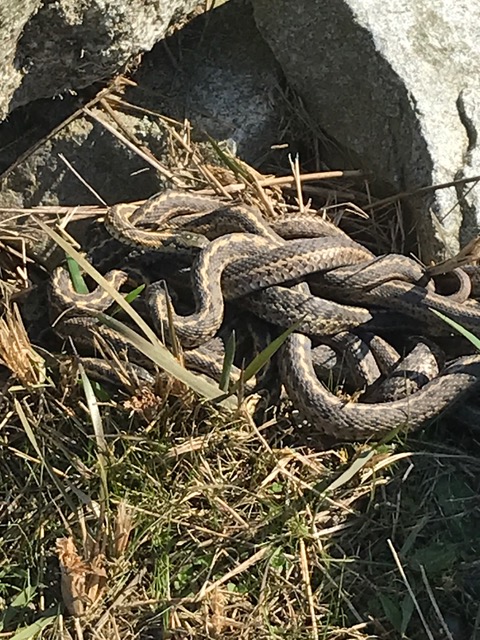
I got to see how the snakes behaved when it was quiet and then when it got busy with traffic. I’d arrive early and the snakes laid about in huddles peacefully basking. Keeping a distance away to not disturb them, I’d walk by a few times to count how many there were. Whenever people and dogs got too close, the snakes retreated into the rocks and reappeared once it was quiet again. This was the routine throughout the afternoons, day after day.
A day in early Spring will be unforgettable for me. For about an hour the trail area in front of the rocks was full of people, dogs, cyclists AND 3 horses. It was so congested that the cyclists couldn’t ride through. All I can hope for is that the snakes get into the rocks and stay there so the children won’t handle or pick them up. I remember the children being crouched down low hovering over the rock edge area where the snakes hang out.
You may wonder why don’t the snakes just leave and be free of all our human activity. They can’t do it yet.
In the early Spring weeks, it’s only the males that emerge from the den. Even though they haven’t eaten in months, instinct keeps them there until the females finally emerge and then they can mate. Once the mating ends then the snakes will migrate to their summer grounds living a solitary life hunting and giving birth.
SOME SNAKE BIOLOGY
I want to share with you some interesting biology of the wild garter snakes. Learning these things has helped me to appreciate what the Beach Grove garter snake’s journey in life is about.
HIBERNATION
The rock berm provides shelter and protection for the hibernaculum that is underground, below the frost line. As they are cold-blooded, they need to gather to keep each other warm and conserve energy over the winter months. They are awake and can move about.
They don’t eat, but can drink, and their bodies can stay hydrated as the hibernaculum will be close to the water table.
MIGRATION
Many people I spoke with expect to see the snakes in the Spring but not in the Fall time. In the Spring, it was early May when I saw the last of them leave the rocks to migrate to their summer grounds. A garter snake can travel as far away as 2 miles to reach their summer grounds.
In the Fall, they returned to the rocks in September for the winter hibernation. I didn’t see many snakes on the rocks, but trail walkers reported seeing snakes crossing the trail to the oceanside grasses.
REPRODUCTION
The male reaches sexual maturity around 1.5 years and it takes the female about 2 to 3 years. The female can produce litters every 1 to 3 years, which doesn’t seem like much time to keep up the den population. Mother Nature compensates by the female’s litter size ranging from a few babies up to dozens, depending on her size.
BABY SNAKES
Baby snakes are born alive, and they look like a long earthworm, but are snake-coloured. Once the babies are born, they’re on their own to care and protect themselves. It takes the young snake about a year to reach a length up to 2 feet.
LONGEVITY
In the wild, the garter snake lives on average about 2 to 4 years. If they stay healthy and are free of threats, they could live many more years.
THREATS TO SURVIVAL
What are those threats that can hinder the snake’s survival?
1. NATURAL THREATS
We have a diversity of animals in our eco-system and almost everything I can think of will eat the snakes. The size of a young snake makes it vulnerable to predation as they can’t move away as fast as an adult snake. If a snake escapes a predator attack and becomes injured, an infected injury may cause death.
The winter temperature can also be a factor. In the event the den has an abnormal drop in temperature, the snakes can freeze resulting in a high rate of death.
2. NON-NATURAL THREATS
Given the location of the hibernaculum in our semi-urban environment they can experience a variety of non-natural threats.
Our cats and dogs can do harm. Cat injuries, especially, can cause serious infections resulting in death.
Unfortunately, people may kill them who fear the snakes or think the snake is dangerous and will hurt them.
They may be killed by automobile tires when the snakes cross our urban roads or while basking on a hot road.
The pesticides we use in our gardens and farm fields may be harmful to them. Lucky for our snakes, the nearby farm fields are organic.
Children may want one, or maybe more, to have as a pet. Possession of any kind of garter snake in BC is not allowed unless one has a permit. As well, I’ve read that wild garter snakes do not do well in captivity.
The hibernaculum can be raided for illegal purposes.
3. STRESS
Something that concerns me is the stress the snakes experience by inappropriate closeness from people and dogs at the rocks. The awareness signs posted at the rocks read “Disturbing snakes and handling them can stress them out”. Without a doubt, we see the snakes react from our getting too close by retreating into the rocks. I’ve read a stressed snake can stop eating and starve to death, as well as, health problems can occur. Whether the amount of human disturbance our snakes receive affects them this way, we don’t know.
When it’s warm, a snake’s response to a predator is to flee or if it feels trapped, it can hiss or maybe strike. If in the grip of a predator, it will thrash violently and can bite. People easily recognize that the snake is disturbed. But in the early Spring, the snakes display differently. They are cold and very sluggish so may not move away or do so very slowly. I’ve often heard from parents and dog owners “my child or my dog won’t hurt the snakes”.
So, they know the snakes are harmless which makes it okay to get close and maybe touch the snakes. It puzzled me for a long time as to why they think this. I think now it’s because they don’t recognize how snakes see us and our dogs – as BIG predators.
ESSENTIALS: WATER + FOOD + BASKING
Basking is essential for a garter snake. It’s a necessity for its survival being as important as eating food and drinking water.
In the Spring, the males need to warm and strengthen their bodies as soon they’ll have to compete vigorously to mate with a female.
In the Fall, basking takes on a different purpose. As the weather cools, the snake’s body temperature and metabolism also lowers. In preparation to hibernate, the snake will stop eating several weeks before it goes down into the den. It’s necessary so whatever food is still in its digestive tract will properly digest.
Basking in the sun at this time of the year helps elevate the snake’s body temperature and metabolism to digest the food. If the food doesn’t digest properly before the snake goes down into the den, the food spoils and the snake will die.
IN CLOSING
So, to sum up, wild garter snakes have a tough life under ordinary conditions. I’d say our Beach Grove garter snakes experience un-ordinary conditions given how accessible the den’s location is to our human activity.
I know from my own experience, if we put distance between ourselves and the snakes, they will bask on the rocks for extended times. With additional protection and the snake-sitter’s presence, I think the snakes could have some degree of harmony at the rocks. As well, education is important to help people understand the snakes better and I’ll work on that with whoever will listen to me.
Our dyke trail park is a beautiful place for us all to visit and enjoy, and also to appreciate seeing these wild snakes in this natural setting. It’s important, though, that we recognize our Beach Grove garter snakes have need to do what is instinctive behaviour and necessary for their survival – to bask on THEIR rocks peacefully.
 Delta Naturalists Society