
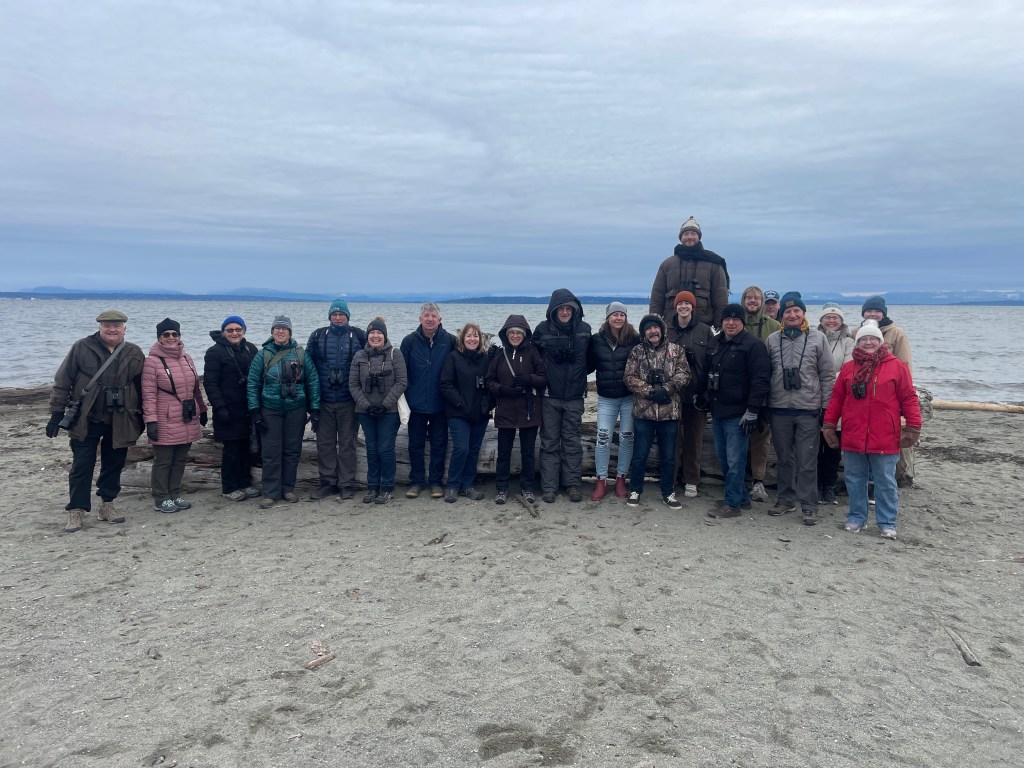
Yesterday’s outing to Centennial Beach was one of those gratifying reminders of why the Delta Naturalists Society occasionally flings open its doors and invites the general public along for the ride! While most outings are members-only affairs, this was one of our scheduled open events, and the response was fantastic.
By 9 AM, more than 20 people had gathered in the playground beside the parking lot: seven Delta Naturalists regulars and a lively contingent of newcomers who had found us through social media and bravely decided to spend their morning peering into bushes with strangers. (Always a promising sign.) Yours truly—Thea—had the pleasure of leading the group.
The birding started immediately. Numerous Bald Eagles dotted the winter-bare trees around us, while a sizable flock of Brewer’s Blackbirds churned through the area with Red-winged Blackbirds and European Starlings stitched in among them.
The bushes and brambles around the pond were alive with sparrows. Large flocks of Golden-crowned Sparrows busied themselves in the leaf litter, and tucked among them were a couple of juvenile White-crowned Sparrows. At the pond itself, there were Mallards (ubiquitous as ever), American Wigeon, and a lone male Northern Shoveler, resplendent with handsome chestnut flanks.
From there, we headed toward the beach under high, overcast clouds that mercifully held their rain. Along the shoreline, a small flock of Sanderling skittered along the surf line, perpetually just out of reach of the incoming waves.
Then came one of the day’s true highlights. A pair of Black Oystercatchers flew past us, their piping calls almost lost in the stiff wind and their long candy-red bills visible against the steel-gray backdrop of the ocean. This caused an immediate ripple of excitement through the group. Oystercatchers aren’t often seen at Centennial Beach, tending instead toward rockier shorelines nearer the Tsawwassen ferry terminal, so this was a real treat for many of us, including some seasoned birders.
Out over the water, large flocks of Brant Geese streamed past in determined lines, while farther offshore, dark flotillas of Scoters bobbed on the waves. From the distance, it was safe to assume these were mostly Surf Scoters, with lesser numbers of White-winged Scoters mixed in, forming those classic low-slung black rafts.
We continued on through the protected dune area, hopeful for a glimpse of the wintering female Mountain Bluebird that had been frequenting the area for weeks. Alas, she was nowhere to be seen, likely lying low and waiting for warmer temperatures and livelier insects. Birding, as ever, keeps us humble.
Overall, the middle stretch of the walk was fairly quiet, though we steadily added species to the list: Song Sparrow, American Robin, Spotted Towhee, and a single Ruby-crowned Kinglet.
Things perked up considerably as we approached the pumphouse. Here, the wetlands were bustling. Large flocks of ducks crowded the water, including Northern Pintail, Green-winged Teal, and a small group of Lesser Scaup. Eight Greater Yellowlegs saw us coming, said “heck no” and beat it, complaining loudly in flight. Enormous numbers of Brant Geese dominated both water and shoreline. A lone Horned Grebe dove repeatedly for food, popping up just long enough to tease us before disappearing again beneath the surface.
In the ditches alongside the path, we added a pair of Gadwall, along with yet more Mallards. Northern Harrier quartered the marshes on both our outbound and return route, gliding low and methodically, searching for a late breakfast.
By the time we looped back, we’d logged 31 species—perhaps a little on the low side for Centennial Beach, but more than respectable given the relaxed pace of an introductory walk. More importantly, most of the group stuck it out for the full two-plus hours, asked excellent questions, and seemed genuinely delighted by what they’d seen.
We very much hope to see many of these new faces again!
Report by Thea Beckman
Photos are on flickr
 Delta Naturalists Society