
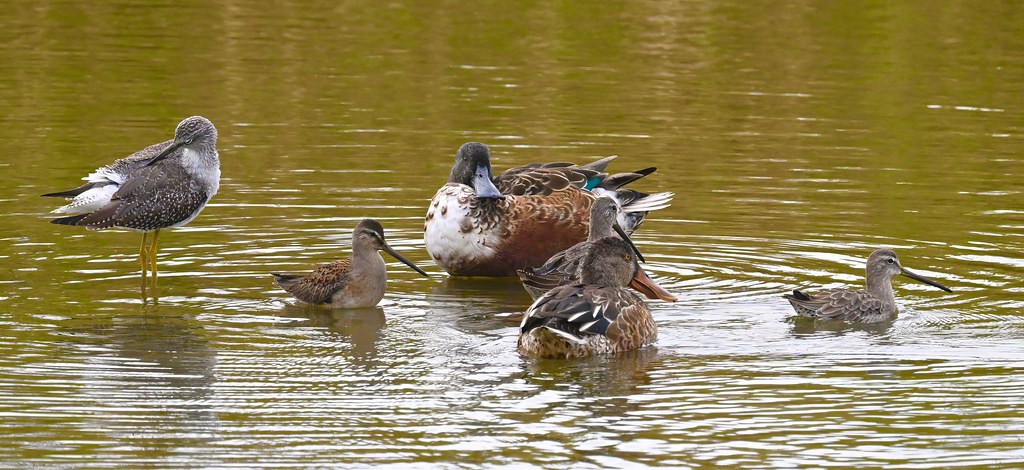
PHOTO: Yellowlegs, Dowitchers, Shovelers by Brian Avent…..
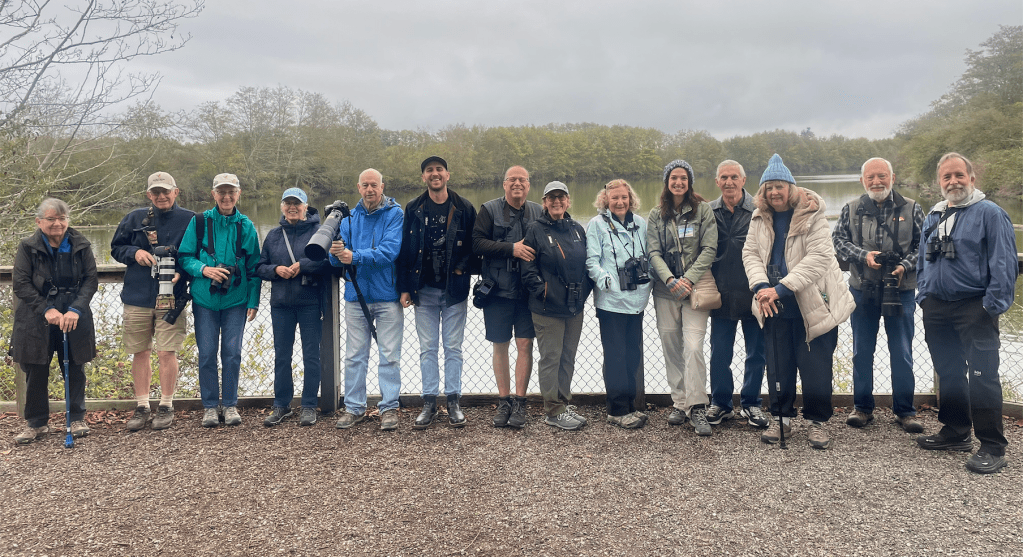
Fourteen Delta Naturalists gathered bright and early at the Reifel Bird Sanctuary on Saturday, October 4th, eager to see what autumn migration had in store. Among our party was a special guest from Salmon Arm, a former DNS member who had made the long trip down to revisit one of her favourite haunts. The weather was kind, the air crisp, and as always, Reifel did not disappoint.
Even before we’d entered the gates, the skies and farmlands surrounding the sanctuary were alive with activity. Vast, swirling clouds of Snow Geese blanketed the fields: a white, honking carpet stretching for what must have been sixty acres, right up to the shoreline. They’re back from their Arctic breeding grounds, and it’s hard not to feel awed by the sheer scale of their return. Mixed in with this spectacle were European Starlings wheeling about in glittering murmurations, a few Eurasian Collared-Doves perched on the power lines, and the bright trills of Red-winged Blackbirds echoed from the reeds.
In the parking lot, Anna’s Hummingbirds zipped between feeders like little green torpedoes, providing entertainment while everyone paid their entry fees. Our first shorebird of the day was a Long-billed Dowitcher that shot past like a tiny missile, flashing that diagnostic white back stripe. At that point, we weren’t sure whether it was long-billed or short-billed (more on that later), but the day was off to a flying start… literally.
Entering the sanctuary proper, we began adding the usual early ducks to our list: Northern Shovelers, Mallards, and Northern Pintails paddling in the ponds. On the first major slough, things were fairly quiet, apart from a lone female Ring-necked Duck, whose silhouette caused a bit of confusion. Was it a Ruddy Duck? The peaked head, the short, uptilted tail… it had us debating. But after some quality peer-reviewed scrutiny through binoculars and Merlin, we settled confidently on Ring-necked Duck.
Perched along the logs were several more Dowitchers, confirming our earlier sighting. And thus began the Dowitcher Dilemma of 2025, the eternal question: long-billed or short-billed? We later confirmed the long-billeds by their single sharp peep calls, though the short-billed variety continued to elude us. Such is birding: equal parts science, art, and educated guesswork.
As we made our way deeper into Reifel’s forested paths, the songbirds showed themselves shyly. Black-capped Chickadees were their usual exuberant selves, joined by Song Sparrows, Spotted Towhees, and a plump, rich brown Fox Sparrows. Someone spotted a Brown Creeper shuffling up a trunk like a little feathered mouse, while Golden-crowned Kinglets flitted maddeningly high in the canopy, as always, almost impossible to get eyes on before they flit off elsewhere. A Downy Woodpecker clung to a dead snag nearby.
The next surprise was auditory: the distinctive rattling k’k’k’k’k’k! of a Belted Kingfisher, followed by the bird itself as it zoomed overhead. We scoured every cedar bough and pine nook for Northern Saw-whet Owls—or any owl, really—but to no avail, alas. Perhaps a little too early in the season for them.
From the tower, the ponds were mostly subdued, but we did add Gadwall, Great Blue Heron, and a distant flock of Double-crested Cormorants skimming across the sky. Glaucous-winged Gulls passed overhead, ever the dependable aerial backdrop, though any other gull species proved too fleeting for positive ID. Someone spotted a lone Barn Swallow, likely one of the last stragglers of the season, procrastinating its journey south.
But then came one of the trip’s most thrilling auditory moments: the unmistakable pig-like grunting—kiddick-kiddick-kiddick—of a Virginia Rail, calling from deep in the reeds. And not just one, but several at multiple locations. Their voices echoed from different corners of the marsh, confirming multiple birds in residence. (We counted seven in total.) We tried a bit of playback (sparingly, and only because breeding season is past), but even so, the rails refused to show themselves.
Then the excitement doubled when, moments later, the soft, rolling whinny of a Sora joined the chorus. Though unseen, hearing a Sora at Reifel was a personal first for several of us (myself included), and it was thrilling to hear it in duet, practically side by side with the rails. Add to that the constant chatter of Marsh Wrens, and you had the full marsh orchestra in concert!
We scanned the dried reed beds along the dike for any sign of Short-eared Owls, but only came up with Northern Harriers. Out towards the coast, vast congregations of waterfowl shimmered in the autumn morning light, more Snow Geese, a scattering of Bald Eagles perched sentinel-like near the water, and a few Great Blue Herons.
As the group looped back toward the entrance, we took one last detour to the first pond and were rewarded with a cluster of Greater Yellowlegs wading elegantly alongside the Dowitchers, giving us an excellent side-by-side comparison. There’s something deeply satisfying about seeing similar species together, as though the birding gods are granting a free tutorial.
The final tally included a few other memorable additions: Green-winged Teal, a large and unexpected flock of Hooded Mergansers (seventeen in total!), a solitary Pied-billed Grebe, Northern Flicker, White-crowned Sparrow, Dark-eyed Junco, and a few Yellow-rumped Warblers, our only warbler of the day. Somewhere in the forest, a Varied Thrush let out its eerie, echoing note, that quintessential Pacific Northwest sound.
By the time we returned to the cars, we’d been birding for nearly three hours, our lists proudly boasting 46 species. The combination of good company, perfect autumn light, and the surrounding symphony of rails, wrens, and geese made for a memorable outing!
Report by Thea Beckman
Photos are on Flickr
Thea’s eBird List
Next Tuesday & Wednesday (Oct 14 & 15) the outings will be to Iona Beach Regional Park in Richmond.
Meet at 9 am by the washrooms.
To sign up for an outing, click on the DNS bird outing schedule sheet.
 Delta Naturalists Society