

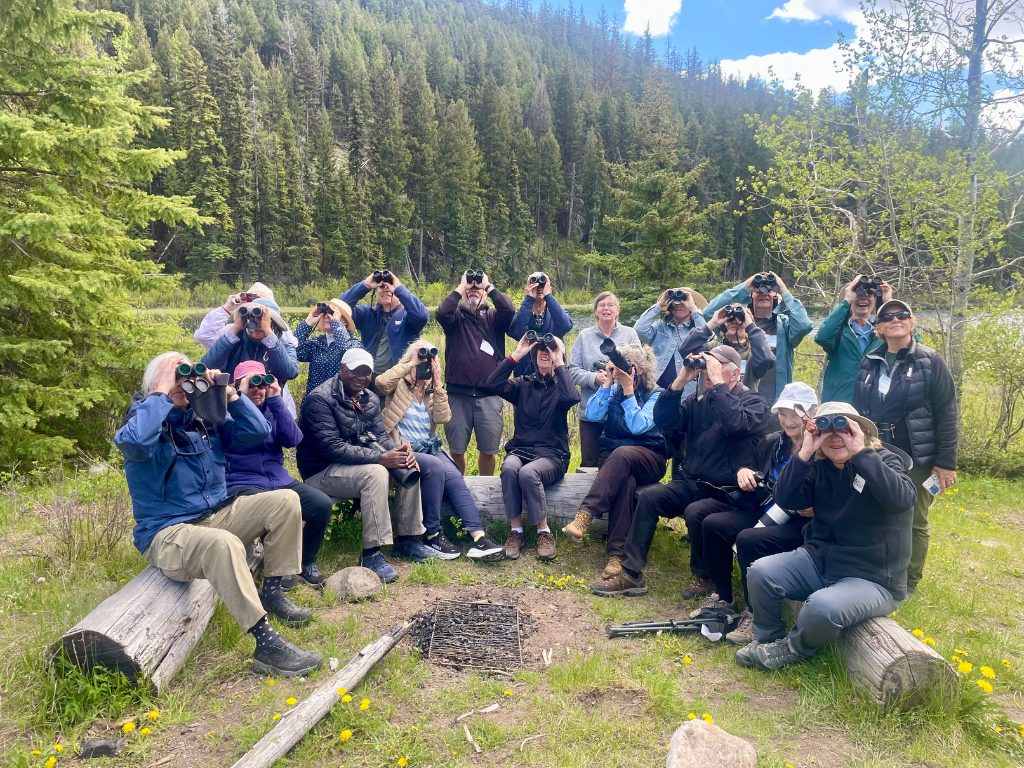
The Nicola Valley and surrounding areas comprise a rich diversity of ecosystems, including moist and dry forests, grasslands, sagebrush, alpine meadows, and many types of wetlands. Several rare and threatened species occur in the area. For this reason—and the timing of the spring migration—a group of 27 Delta Naturalists decided to visit the Nicola Valley for a multi-day field trip. They were: Thea Beckman (group leader), Bruce Taylor, Nicki Brockamp, Chris McVittie, Peter Ward, Rosemary Beckman, Christine Gaio, Christine McGilvray, Colin Huggett, Debbie Cook, Dottie Uhlman, Douglas Chase, Estelle Martel, Gloria Woolfrey, Jan Patenaude, Janet Heavyside, Jim Kneesch, Jonathan Mwenifumbo, Lee Wright, Lorraine Mwenifumbo, Pat Smart, Patti Meggy, Robert Winston, Stephanie Huggett, Susan Gemeinhardt, Vicky Huntington, and Joan Forsyth.
Day 1: Sunday, May 25th
Lundbom Commonage Lakes & Grasslands
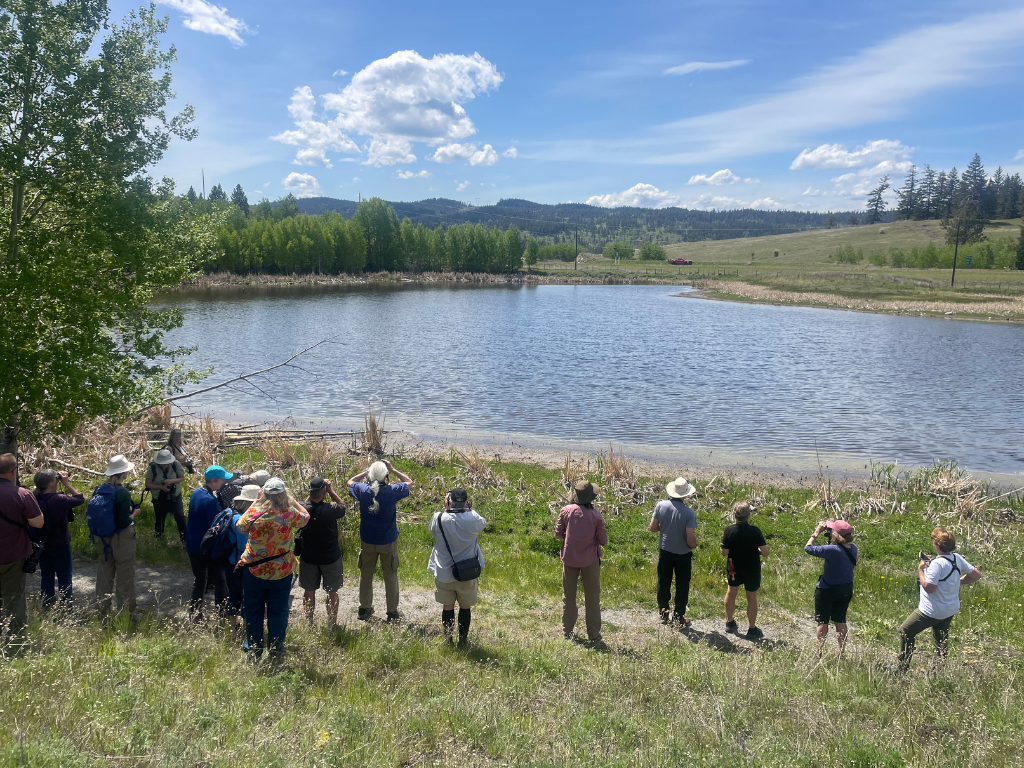
Birding the pond next to Laurie Guichon Memorial Grasslands Interpretive Site. (Photo by Thea Beckman)
At 12 PM sharp, 25 Delta Naturalists convened on the Ramada Inn parking lot to kick off five days of birding in the Nicola Valley. Our first destination for the fieldtrip was Lundbom Commonage and its series of lakes and surrounding grasslands. The first lake was tucked in a grove of Aspen, a popular foraging spot for migrating warblers. Yellow Warbler, Orange-crowned Warbler, and Yellow-rumped Warblers were calling but trying to find them in a shimmering sea of green and gold foliage was like trying to find an amoeba swimming about in a glass of water. (The latter most bird eventually showed itself flycatching on the far bank of the pond.)
An Osprey nest—complete with occupants—stood sentry over the pond, dotted with waterfowl. A brief pan around revealed a surprising variety of species. All three teals were present (Blue-winged Teal, Cinnamon Teal, and Green-winged Teal), as well as Mallards, Lesser Scaups, Ruddy Ducks, American Wigeons, and Northern Shovelers.
Spotted Sandpipers were restless and vocal, flitting constantly along the banks. Killdeers were either shagging or fighting in the grass (or both), attracting a lot of attention with their flashing white and rust-colored rumps. Tree Swallows were the most common aerial birds swooping over the pond and seemed to be nesting in a large tree nearby. A closer inspection of the action above our heads revealed the occasional Northern Rough-winged Swallow.
After thoroughly inspecting the pond for the Red-necked Phalarope that was seen by an earlier scouting party, but coming up short, we drove on up to Marquart Lake, where Barn Swallows were the more common aerial birds. A lone Common Loon in full breeding plumage cruised out on the water but otherwise the lake surface appeared quiet.

Common Loon (Photo by Bruce Taylor)
We struck out along the lake shore, flushing a sizable flock of Brown-headed Cowbirds, glistening iridescent blue-black in the sunshine. Brewer’s Blackbirds picked along the muddy shoreline. A family of Clark’s Nutcrackers—a parent and three whiny kids—chattered among the tall pines. And where the shore bent gently around a rolling hill, a small lake inlet hid its treasure of a male Barrow’s Goldeneye, a female Hooded Merganser (star-crossed lovers, perhaps?), and a flock of Canada Geese.
Hearing the song of a Vesper Sparrow, we hiked up the hill to investigate and was able to get a good look at the little grassland sparrow. Beyond the fence upon which the sparrow was singing, an American Kestrel hovered, holding its position in the rushing wind with immaculate precision before plummeting to snag itself what looked like a vole (short tail).
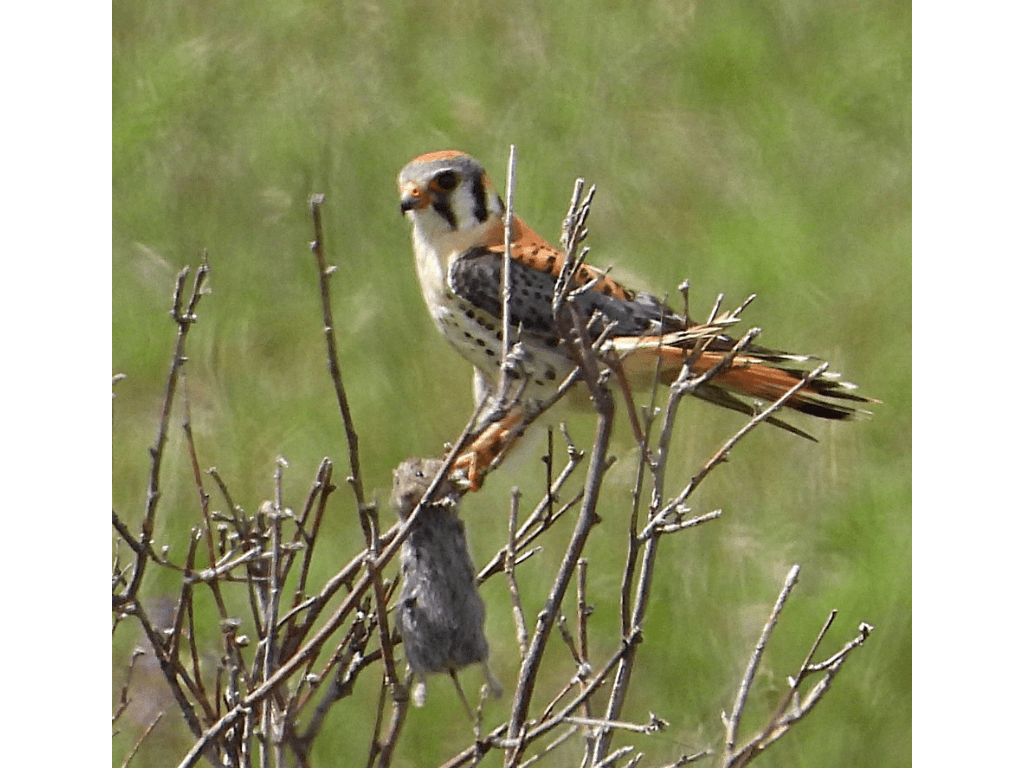
Male American Kestrel with unlucky vole prey (Photo by Susan Gemeinhardt)
The final and biggest lake, Lundbom Lake, was fringed with evergreen forests resonating with birdsong. Loudest of them all were the Ruby-crowned Kinglets, which were letting rip with their rich, burbling spring song. We also heard flocks of Pine Siskins, Western Tanagers (a female briefly perched atop a fir tree), and Evening Grosbeaks. The ubiquitous “campground Common Ravens” harassed a Bald Eagle; a Red-necked Grebe bobbed about right in the center of the lake; and the owl-like hooting of Pied-billed Grebes emanated from somewhere within the reed beds.
We ended our day on the lake shore, watching jaunty Yellow-headed Blackbirds foraging in the mud, frolicking in the reeds, and filling the air with harsh calls that sound like old printers.
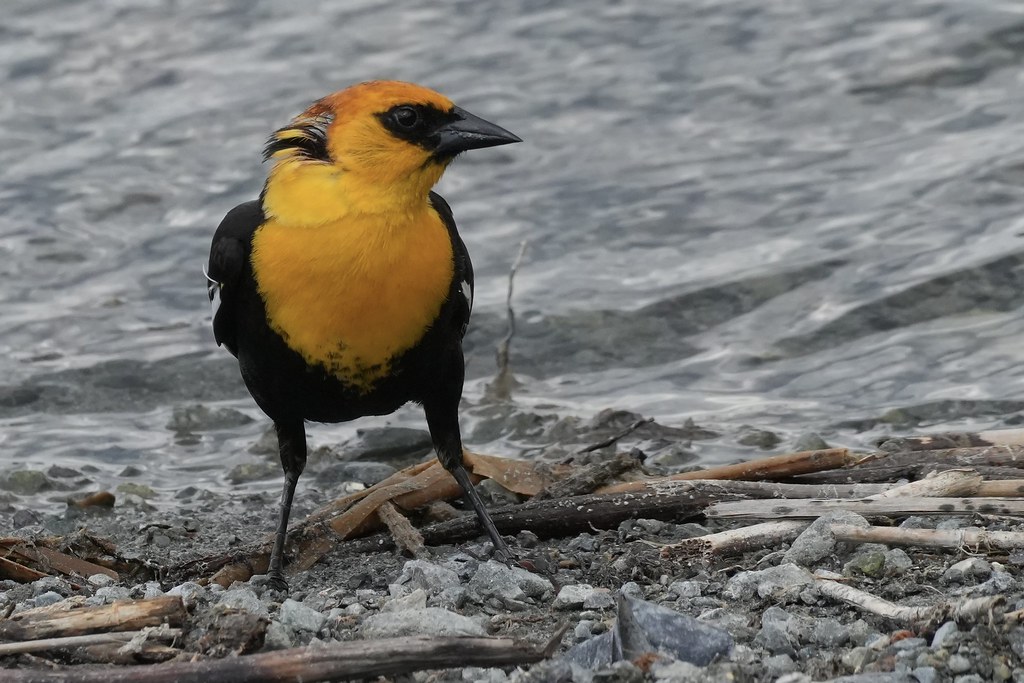
Yellow-headed Blackbird with injury on back of head—perhaps evidence of a tussle with another blackbird? (Photo by Chris McVittie)
Night birding along Lindley Creek Road

Sunset view of the Nicola River from Lindley Creek Road. Note the mammatus clouds, which are indicative of strong convection (Photo by Thea Beckman)
After dinner at Mr. Mike’s Steakhouse, a small party of us struck out along Lindley Creek Road in the hopes of snagging (by ear or by sight) a Common Poorwill or an owl. While we enjoyed stunning views over the Nicola Valley from some of the road’s higher vantage points—and had a little too much fun looking for heat signatures with Nicki and Bruce’s infrared camera—the birds had settled for the night. The only exceptions were a few restless Vesper Sparrows and a Swainson’s Thrush whose call was so diluted by distance, I almost thought I imagined it.
_______________________________________________________
Day 2: Monday, May 26th
Hamilton Hill Roadside Birding
The gang was all gathered and ready to depart by 8 AM sharp so we made our way to our first birding destination: Hamilton Hill Road, which runs through a good mixture of grasslands and stands of mixed deciduous trees. A gorgeous male Mountain Bluebird on a powerline—dressed in a fine suit of azure—was our signal to stop and so we pulled over to admire him. He was later joined by a female dressed in more understated garb.
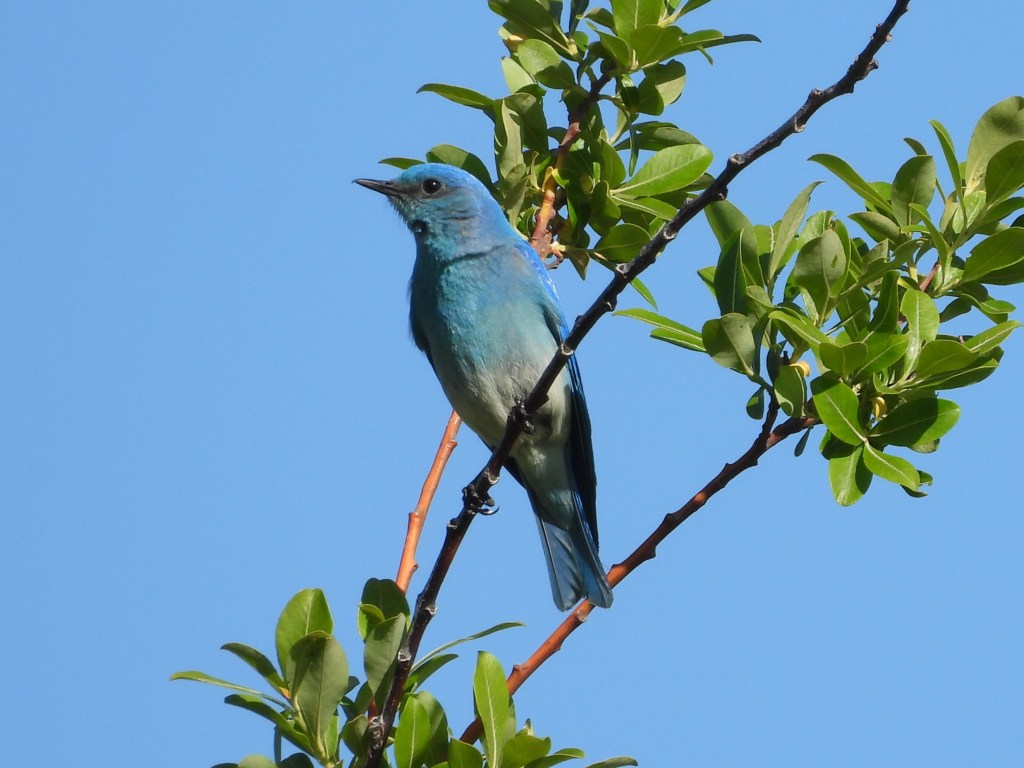
Mountain Bluebird, male (Photo by Bruce Taylor)
An American Goldfinch made a brief appearance above a tall stand of aspen while, beneath it in the thick of the foliage, a Yellow Warbler taunted us with song (remaining obstinately elusive). Chipping Sparrow called harshly from the dry bushes and an American Kestrel surveyed the grasslands from the vantage point of an enormous gnarled snag. The kestrel had to defend this spot from a Northern Flicker and later a pair of Western Meadowlarks, who must have fancied this high point for their morning warbling.
A Red-tailed Hawk sailed overhead and used the strong winds to hover in a manner reminiscent of a Rough-legged Hawk. (We would have traded it for the latter but the Gods of Birding will not be bartered with.)
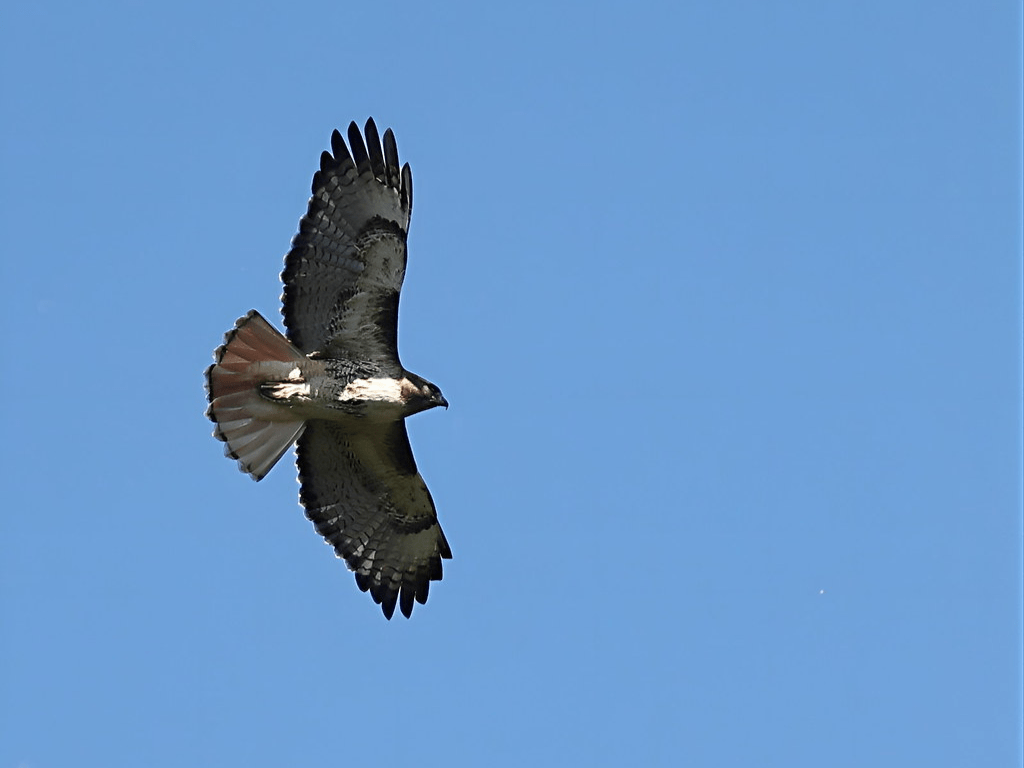
Red-tailed Hawk soaring in a blue sky (Photo by Chris McVittie)
A Hairy Woodpecker rapped out its drum against a large wooden utility pole. We also heard Northern House Wren, Mountain Chickadee, and Western Tanager calling, among other songbirds.
Finally, having recently schooled myself on the songs of grassland birds, I was able to recognize a Clay-colored Sparrow ziiip-ziiip-ziiiip’ing in the distance, corroborated by Peter Ward, whose knowledge of birdsong is surpassed only by the AI that lives inside the Merlin app.
We stopped on another two occasions along Hamilton Hill Road, each time relishing in the garish colors of the Mountain Bluebirds who clearly find the habitat and kind provision of bird boxes to their liking. We also added a Red-naped Sapsucker to our growing list of birds.
Kane Valley Road: Menzies Lake Trail
Soon after turning onto Kane Valley Road, we pulled the cars over at Kane Valley Ski Trails, a network of pathways through the mixed deciduous and evergreen forests that would appear to be a popular destination for winter sports aficionados. In total, we walked 3.5 km out and back on the Menzies Lake Trail, turning around at its namesake lake. The forests were somewhat disappointingly quiet. We saw a Red-breasted Nuthatch, Hairy Woodpecker, and a Western Wood-pewee and heard Mountain Chickadees and a Brown Creeper but, alas, none materialized.
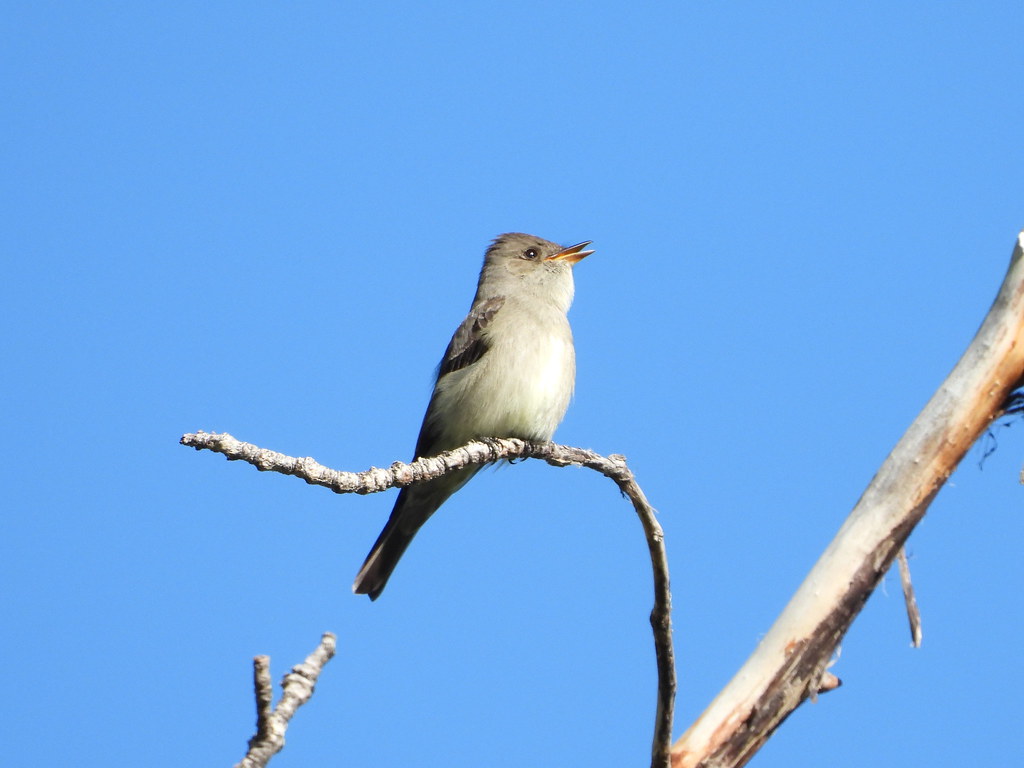
Singing Western Wood-Pewee (Photo by Nikola Brockamp)
At the lake were the ubiquitous Red-winged Blackbirds, Canada Geese, and a Common Loon. A member of our party thought she saw a Western Bluebird. Tree Swallows wheeled and dived over the lake water.
Kane Valley Lake & Recreation Site
The best birding spot of the day, aside from our first stop on Hamilton Hill Road, must have been the random place we decided to pull over to investigate a suspected Cooper’s Hawk, which had flown into a towering fir tree (it was definitely an accipiter but went unconfirmed). To our left, the lake water was rich in reeds and other pond vegetation, which meant that there were actually birds to be seen. To our right, a steep bank led up to a heavily-treed horse trail. Both sides of the road were alive with birdsong!
There were Ring-necked Ducks, Lesser Scaups, and a lone Mallard on the water. Marsh Wrens chittered loudly from the reeds: we even managed to locate a nest and the comings-and-goings of its residents kept several members of our party thoroughly entertained.
Emanating from the forest behind us were robust spring song of a Cassin’s Vireo (possibly two individuals), a Hammond’s Flycatcher, and a mystery bird that would fire off a single whistle (like the hoot of a small owl) before shutting up for several minutes. A Pied-billed Grebe called its haunting, owl-like cry from the lake and so we thought that that was perhaps what we’d been hearing. But then the mystery bird kept calling and it sounded very much like it was coming from the forest, which is definitely not the preferred habitat of a Pied-billed Grebe. If I had to hazard a guess, I’d say it was a Northern Pygmy-Owl, but the most I’d wager is $10, which tells you how incredibly uncertain I am.
We took our lunch at Kane Lake Recreation Site. I wandered off to locate the Orange-crowned Warbler I’d heard and not only succeeded in locating the drab little warbler but also stumbled across a Steller’s Jay. A Rufous Hummingbird seemed to enjoy a tall perch right in front of the feasting birders and a couple of members of our party saw a Northern Harrier.
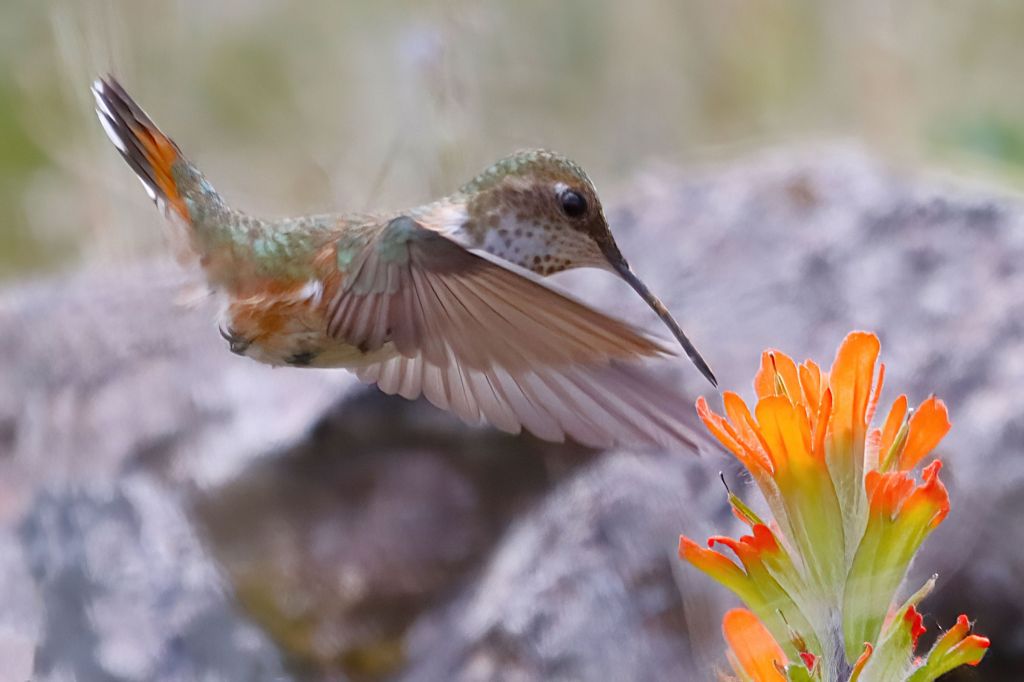
Female Calliope Hummingbird (Photo by Jonathan Mwenifumbo)
Our final outing for the day was a 2 km nature trail loop to Secret Lake. We had the most action in the carpark with a Townsend’s Warbler and Pileated Woodpecker calling from the surrounding forest but not seen. Evening Grosbeaks and Pine Siskins flitted from treetop to treetop. However, with the wind battering the landscape, the trail was devoid of feathered life with the exception of the occasional American Robin. (JAR: Just Another Robin)
Around 2 PM we returned to Merritt, stopping in at a pond on the Hamilton Hill Road, where we were rewarded with a Barrow’s Goldeneye, two Lesser Scaup, a Bufflehead and—drumroll please—a sleepy Redhead. Total species for the day was a respectable 54, considering the long stretches of quiet we had!
_______________________________________________________
Day 3: Tuesday, May 27th
Lindley Creek & Midday Valley Road Loop
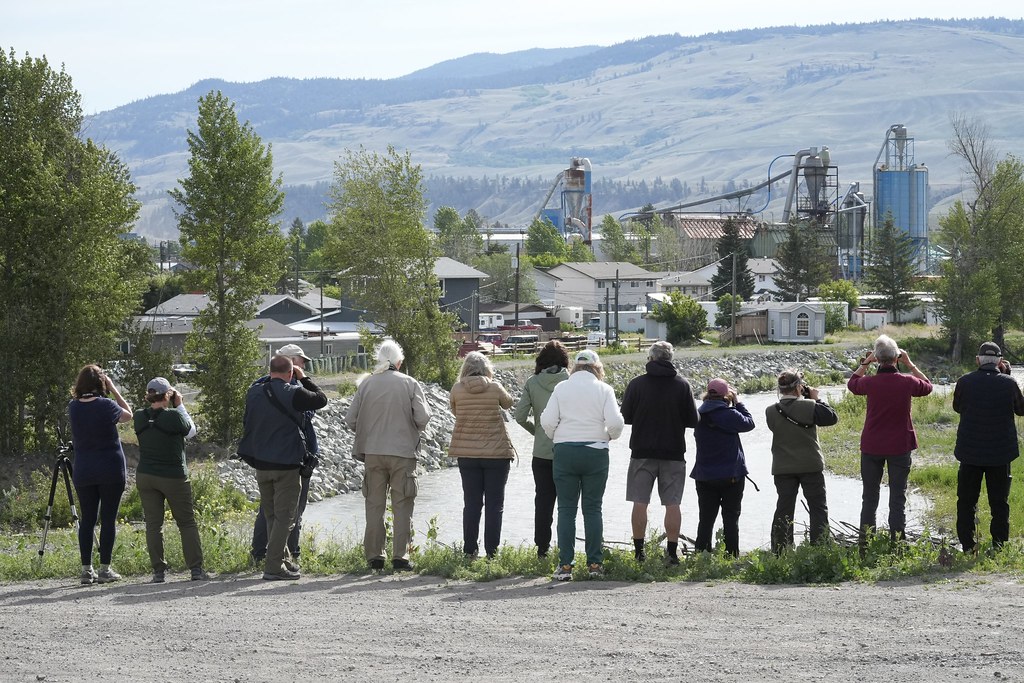
Apparently, in Merritt, the early bird catches a cold and so we headed out a bit later at 9 AM, giving the day a chance to warm up a bit. (The warmth brings out the insects, which brings out the birds.) Our plan for the day was to complete the Lindley Creek and Midday Valley Road loop with several stops along the way to explore a variety of habitats.
Our first stop was just past the Houston Street bridge, which vaults over the Coldwater River. We were there to inspect the Osprey nest, which was empty, and ended up with the first 15 birds of the day, the highlights of which were three Mourning Doves, a singing Western Meadowlark, our first decent look at an Evening Grosbeak, and Yellow-bellied Marmots, which lounged about on the rocks on the river banks, soaking up the morning sun. We also got our first House Finches of the trip. As we were about to leave, we spotted the Osprey and an American Kestrel, the latter with an unfortunate rodent dangling from its talons.
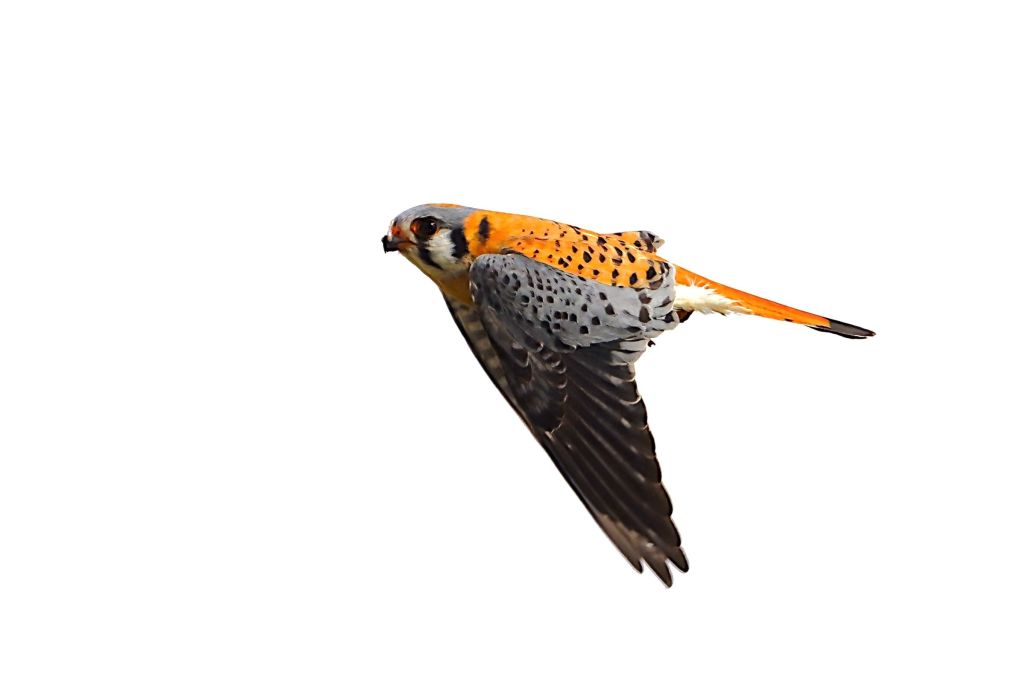
American Kestrel fly-by (Photo by Jonathan Mwenifumbo)
The next stop was an old quarry opposite the Rodeo and Fair Grounds, where we’d noticed wheeling flocks of swallows on a previous drive-by. Several Northern Rough-winged Swallows were nesting in a series of holes that had been drilled into an enormous boulder. Violet-green Swallows were seen higher up against the cliff face, flashing iridescence in the morning sunlight. A Turkey Vulture wobbled on by as it sought thermals to glide on.
Stop number three was a lookout point with panoramic views over the Nicola River and its flanking valley, carpeted with cultivated fields. The benefit of being this high up was that it positioned us about level with the treetops that sprouted from the steep slopes beneath us. And this meant that any hard-to-see, canopy-flitting bird was now in our direct line of sight.
Right away, we were drawn from the cars towards the birdsong emanating from the creekside forests. A Hammond’s Flycatcher whee-zipped, Nashville Warblers warbled, and Lazuli Buntings burbled and trilled. One-by-one, we hunted them down and were rewarded with clear sightings. High up in the cerulean sky, Red-tailed Hawks, Common Ravens, and Bald Eagles soared (separated by great distances, of course).
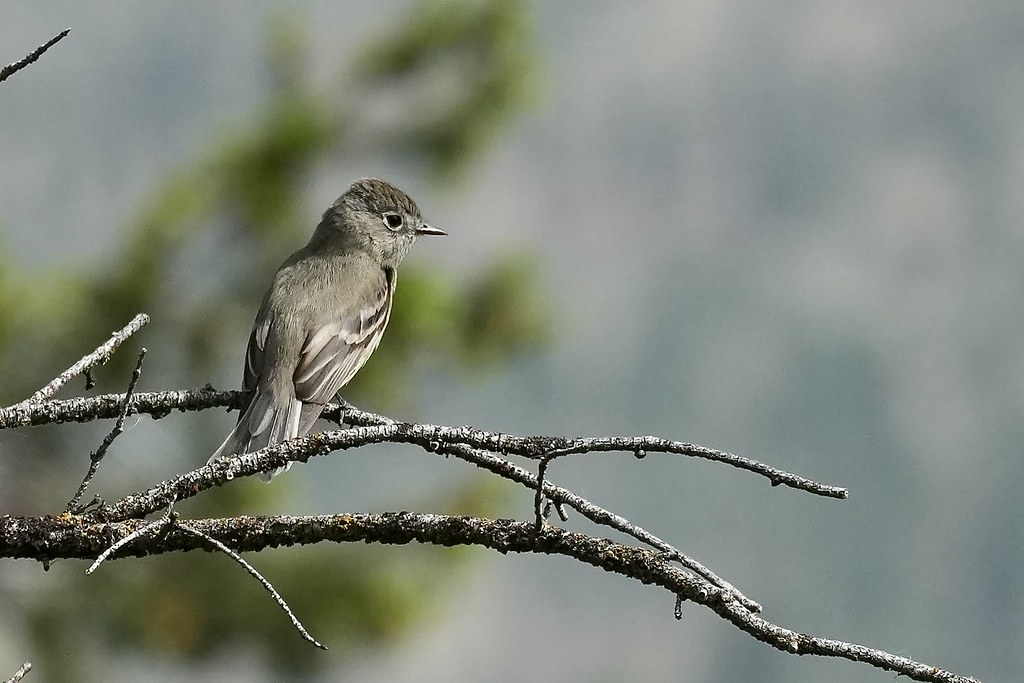
Hammond’s Flycatcher (Photo by Chris McVittie)
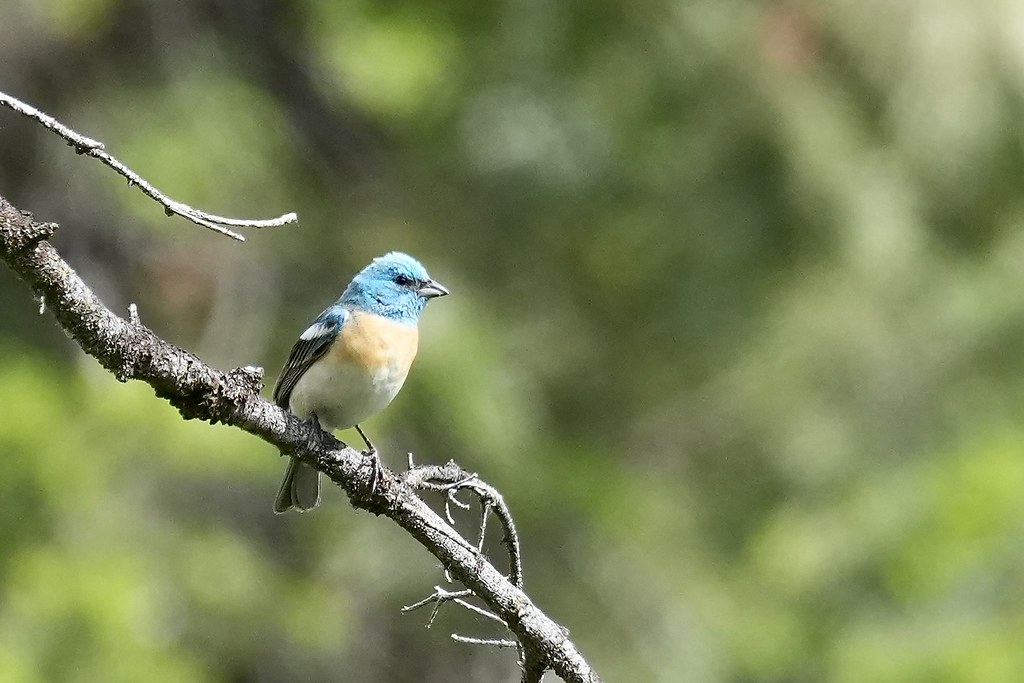
Lazuli Bunting (Photo by Chris McVittie)
The next spot was just as busy with birdsong. This time we chased (and found) a vociferous MacGillivray’s Warbler, which happened to be hanging out in the same vicinity as a flock of foraging Evening Grosbeaks. We also added Western Tanager, Cedar Waxwing, and Hairy Woodpecker to the list. We saw a tiny hummingbird flitting on the ridge above the road but aside from a light rust-colored wash across its belly, the absence of any other markers left its identity undecided. (It could have been a female Calliope or Rufous Hummingbird.)
Stop number five for the day was proof that serendipity is a force in this world. On a previous scouting trip, a small group of us were driving Lindley Creek Road with our windows open, listening for birds. At one particular spot in a thick forest, we heard a song we didn’t recognize and so we pulled over. The song persisted, which Merlin identified as a Cassin’s Vireo. It took us a few seconds to locate the singing bird, which alighted on a large fallen branch leaning against the bole of a fir tree. From there, it flitted into a tiny, cup-shaped nest in a low bush. We had followed the clues to discover an active Cassin’s Vireo nest!
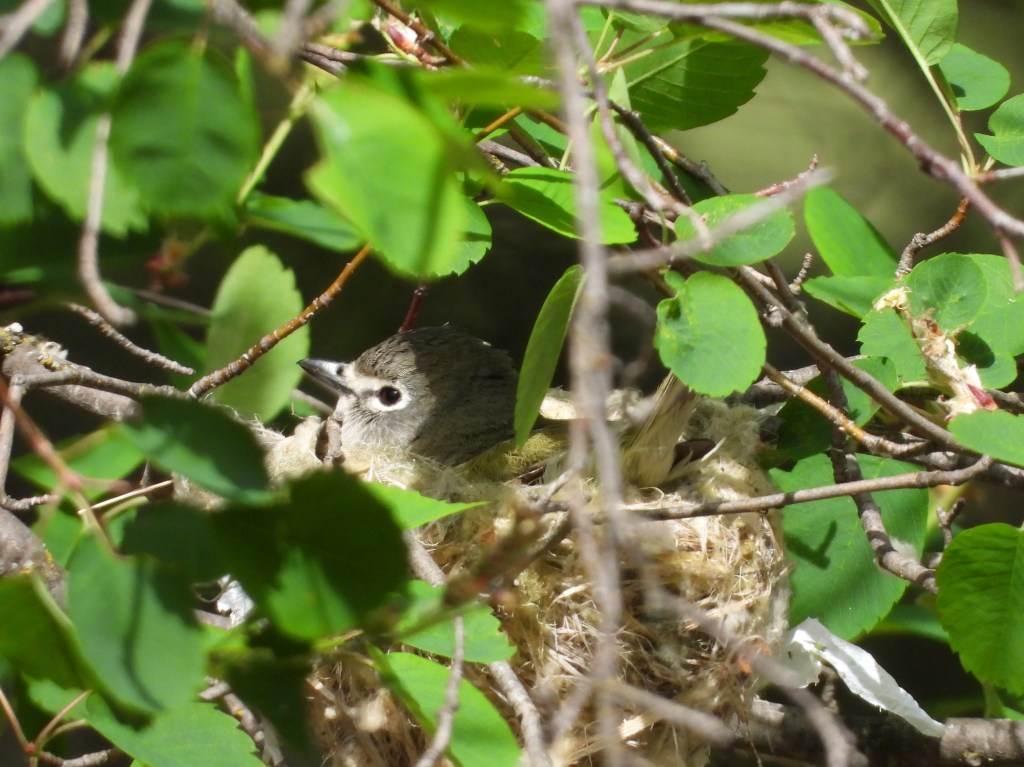
Cassin’s Vireo sitting on a nest (Photo by Bruce Taylor)
Inside the nest, which we had inspected on an earlier visit (with the bird absent), we discovered two eggs of different shapes and colors. We suspect the one egg belongs to the parasitic Brown-headed Cowbird.

Cassin’s Vireo nest with suspected Brown-headed Cowbird egg on the right (Photo by Thea Beckman)
(Important: Please don’t disturb birds sitting on their nests. We only approached this one—and didn’t touch it—because the parent was absent. After snapping a quick picture, we retreated to a respectful distance.)
Stop number six was next to a small pond, which had Mallards, a Green-winged Teal, and a female Barrow’s Goldeneye on it. Spotted Sandpipers peeped relentlessly from the shores and Chipping Sparrows cried harshly from the surrounding grasslands. We got our first Mountain Bluebirds of the day here, too, and even managed to track down a Dusky Flycatcher, which several of us saw perched in the high, barren branches of a dead tree.
The final stop for the day was at an old cattle or horse corral, where a dramatic showdown was taking place between a furious Northern House Wren and a rather oblivious Red-naped Sapsucker. The dispute was over a cavity nest so perfectly round in structure, it looked man-made. (Then again, nature does have a superlative talent for geometry.)
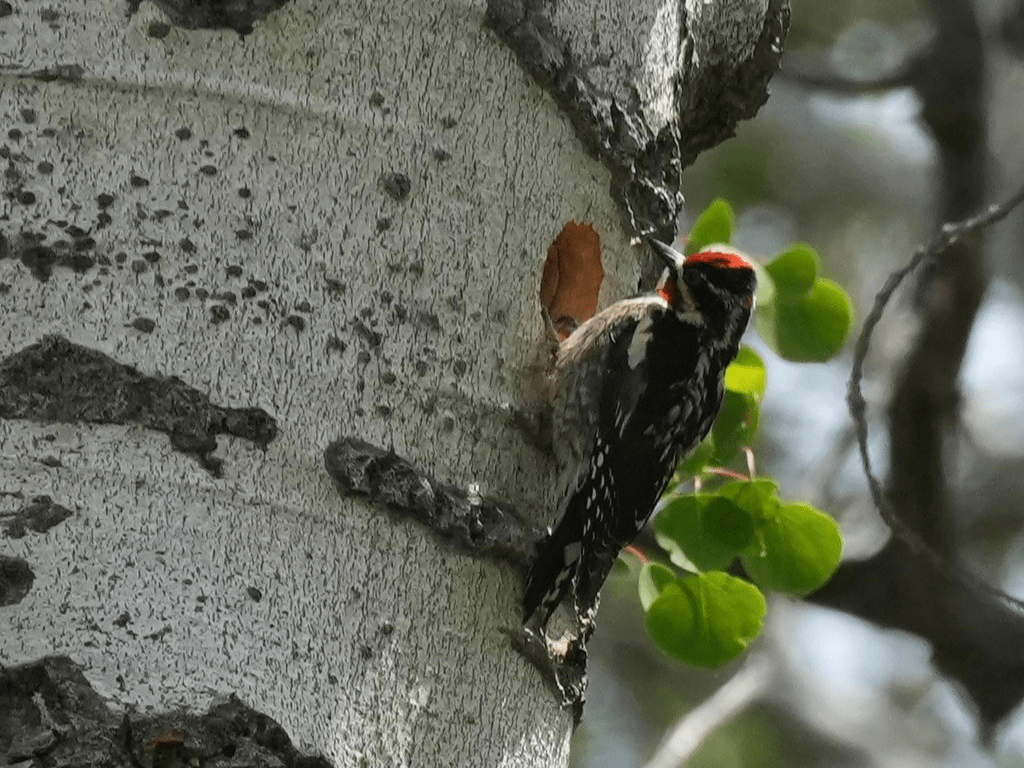
Red-breasted Sapsucker (possibly) claiming the cavity nest belonging to a Northern House Wren (Photo by Chris McVittie)
A small flock of Cassin’s Finches flitted about, a Yellow Warbler chattered from the reeds surrounding a small body of water tucked into the trees, and a couple of mystery sparrows (Lincoln’s? Vesper?) kept some members of the group guessing. Finally, we saw our second MacGillivray’s Warbler of the day and, being in far more open country, some snagged a better photograph.
There were many other species seen and heard during on this prolifically productive 25-kilometer loop. Our final tally for the half day was 51 species.
Confluence of Nicola & Coldwater Rivers, “Downtown” Merritt
An hour-and-a-half before we were scheduled to meet for dinner, we met at the end of Quilchena avenue at the confluence of the Nicola and Coldwater Rivers. This rumored local hotspot for birding proved to live up to its reputation and among many of the “usual suspects” we’d seen several times on our trip, we saw Bank Swallows, Vaux’s Swifts, and the truly resplendent (traffic cone orange) Bullock’s Oriole. Our total species list for the day was 54 birds.

Bullock’s Oriole (Photo by Bruce Taylor)
_______________________________________________________
Day 4: Wednesday, May 28th
Nicola Lake Dam & Cut-off Road
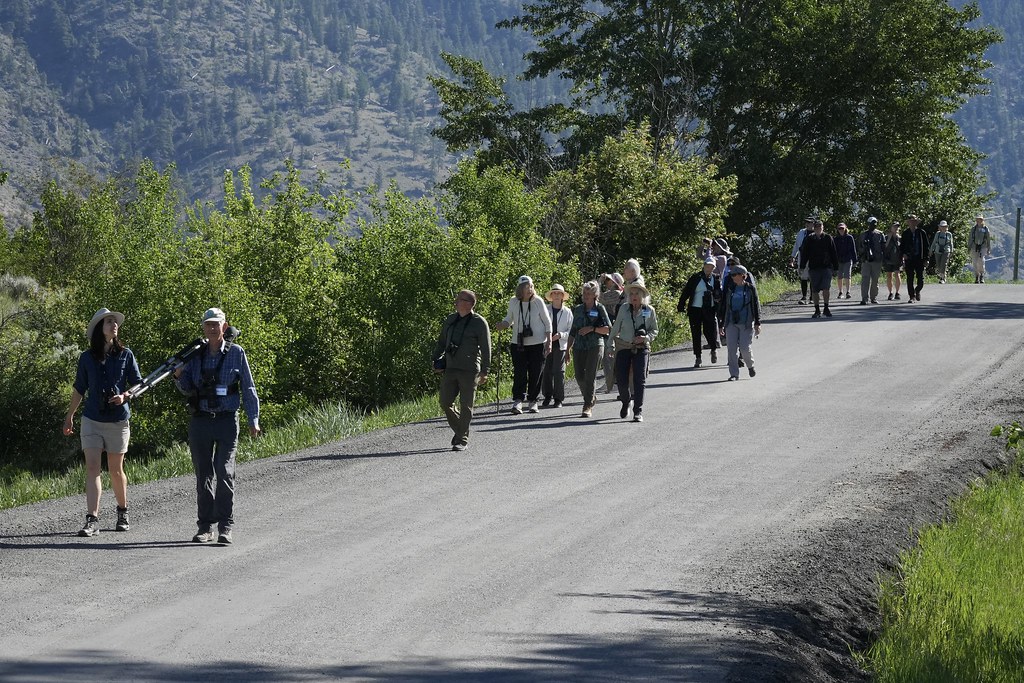
With a forecast of 30+ degrees, we departed from the inn a little earlier in an attempt to beat the heat. Today’s destination was Nicola cut-off road, which follows the Nicola River as it flows through the Nicola Dam and out of Nicola Lake (say “Nicola” one more time, Thea). The sky was busy with its usual traffic of European Starlings, Brewer’s Blackbirds, and Eurasian Collared Doves. Yellow Warblers and Spotted Sandpipers were calling insistently from the riverside vegetation and banks, respectively. Two pairs of Bald Eagles adorned nearby trees, their enormous bulk and white heads making them easy to spot. A Western Meadowlark filled the morning air with its rich, tropical fluting and two Turkey Vultures soared high above.

Western Meadowlark singing (Photo by Nikola Brockamp)
The target for this section of the river was American Dipper, but we came up short. Instead, we watched Gray Catbirds frolicking in the bushes and chasing each other across the river. There were Cliff Swallows nesting under the bridge with the odd Barn Swallow mixed in. A female Common Merganser did a fast fly-by (the only one we’d seen on the trip so far). Beyond the dam, on the other side of the highway, we could hear a Common Yellowthroat singing. I was scanning the river for ducks, and found a pair of American Wigeon, when I spotted an unexpected Wood Duck, which showed up as rare for the area on eBird. Since it seems no-one else saw the bird before it disappeared into the reeds, you’ll have to take my word for it.
We had a fruitful hour or so of birding along this road but with the day swiftly heating up, we herded the cats back to the cars to our next location: a pitstop on the north side of the lake in a residential cul-de-sac—Harmon Estate Road—which had looked promising on a previous scouting trip.
(On the way there, we saw a gorgeous lemon-breasted Western Kingbird on a power line.)
Harmon Estate Road & Monck Provincial Park
On Harmon Estate Road, we picked up Clark’s Nutcracker, a Steller’s Jay, a singing Northern House Wren, and a Yellow-rumped Warbler. A grumpy-looking resident eyed us warily while puffing his cigarette and so we finished up our birding and headed over to Monck Lake Park, a really lovely lakefront, pine-forested camping site.
The birds were fairly quiet, save for the usual Chipping Sparrows and a vocal American Robin. A Common Loon populated the middle of the lake but there was no sign of any grebes, gulls, or terns. Jonathan mentioned that he and Lorraine had seen a nuthatch on a large dead tree a little further up from the picnic site when they had visited the park on the previous day. So, several of us hiked along the lake towards the snag in hopes of snagging (*snort*) ourselves a new bird for the list. At first, the scene appeared disappointingly quiet—another target bird slips through our binoculars—but then a little Pygmy Nuthatch swooped in from a nearby pine tree and disappeared into a nesting cavity. Success!

Pygmy Nuthatch with partner tucked into nesting cavity (Photo by Susan Gemeinhardt)
At the very same time, not far behind us in the lake, two Common Loons flirted and swooned and courted, swimming in tight circles, dipping their heads into the water, and then flapping their wings and unleashing their iconic haunting cry. Delightful!
A little further on, we got duped by a juvenile Bald Eagle into thinking we’d seen a Golden Eagle but the location of the white patches on the bird (in the wing linings and on the belly) convinced us that our biggest target of the day remained elusive. There wasn’t much else to see in the park and so we enjoyed our lunch besides the lake before bravely deciding to tackle the journey to Beaver Lake Ranch.
Beaver Lake Ranch & Guichon Ranch Pond
A quick stop at Quilchena Hotel rewarded us with a Black-billed Magpie, a small flock of Vaux’s Swifts, even more damn Osprey, and a near case of heat stroke. A member of our party braved the heat to scout the grounds and found a Bullock’s Oriole and some Barn Swallow nests that had been sadly scraped off the nearby barn.

Two Ospreys in a nest (Photo by Chris McVittie)
From the hotel, we barrelled through to Beaver Lake Ranch which used to be a birding hotspot of legendary proportions in the Thompson-Nicola valley. Today, it looked more like a desiccated scar in the landscape, with ancient mummified reeds standing stiffly in the wind. Someone heard a Marsh Wren calling. A pale brown-and-white raptor flew overhead, flummoxing the lot of us. Its patchy white-and brown underwings were reminiscent of a Rough-legged Hawk but it could just as easily have been a juvenile Red-tailed Hawk.
Our final stop was the lush oasis of Guichon Ranch Pond, which turned out to be a wonderful conclusion to the day’s birding. A flock of 19 Wilson’s Phalaropes paddled on the pond’s surface and there was a lovely treasure trove of ducks to explore: American Wigeons, Cinnamon Teals, Blue-winged Teals, Gadwalls, and Lesser Scaups. We also spotted two Eared Grebes and three pairs of Canada Geese parents with their broods of fuzzy goslings.
But the crowning jewel in this tiara of waterfowl was a very, very, VERY lost White-winged Scoter, unmistakable as a large, black duck with a robust orange bill and white eye makeup. Of course, it came up on eBird as rare and unreported so we made sure to add photographs as proof that we know a scoter when we see one.
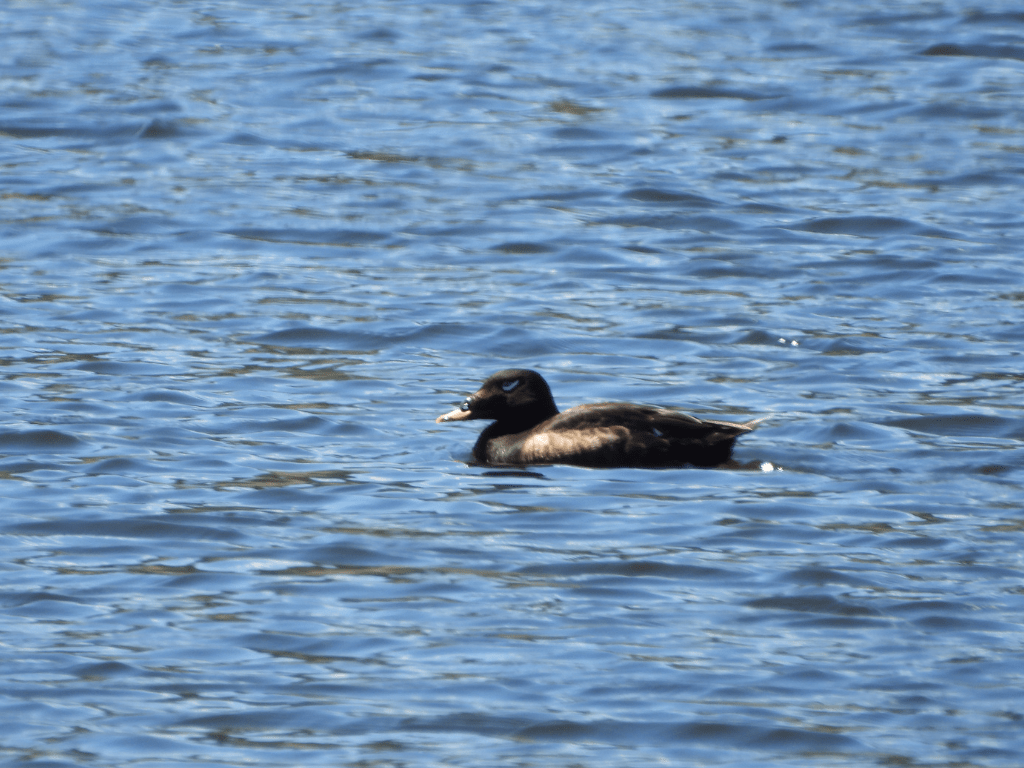
The rare White-winged Scoter that showed up on the Guichon Ranch pond (Photo by Susan Gemeinhardt)
With that final treat for the day, we drove back to Merritt, enjoying the stunning scenery of glittering lake and its rolling flanks of sagebrush.
Total species for the day = 56!
Final Morning
We awoke to a blustery sky bloated with clouds. Given our experience with the wind in the valley—being intense on even good days—we decided to cancel our birding plans for that morning. The remaining 14 or so birders met in the parking lot of the Ramada Inn to do a final debrief on the trip and bid our farewells.
The total species tally for the trip was 112 (including the Red-necked Phalarope and Herring Gulls that were seen by an earlier scouting party, and the Belted Kingfisher and Say’s Phoebe seen by group members in their campsites or on individual birding expeditions).
Now I’d say that was a successful field trip!
More photos on flickr
 Delta Naturalists Society