

PHOTO: Marsh Wren by Pat Smart….
12 Delta Naturalists gathered at the Brunswick Point parking lot on what turned out to be a fine spring Saturday morning. They were Thea (group leader), Nadine, Nicki, Bruce, Janet, Estelle, Freddie, Doug, Liz, Alan, and Shannon. Pat later joined us on the dyke.
We immediately set to work identifying the many bird species flying overhead, diving in the river, and flitting about the bushes. A small flock of Black-bellied Plovers—in their new, somewhat scruffy, breeding plumage—flew overhead followed by an all-male triad of Common Mergansers. A noisy Killdeer called from the adjacent farmland. Mallard, American Wigeon, and surprising numbers of Red-breasted Mergansers populated the river. Two stately Mute Swans had moored alongside the river, affording us lovely close-up views.
Savannah Sparrows were out in force, their thin cricket-like chirpings playing out as the soundtrack to our morning birding. Song and White-crowned Sparrows were just as vocal, and we got brief glimpses of Golden-crowned and Fox Sparrows.
A striking male Rufous Hummingbird perched atop a bramble, his apricot gorget sparkling in the morning sunshine. Later on, we saw him performing his fierce rise-and-swoop display, complete with a burst of electronic buzzing at the trough of his dive. Very intimidating. I’m sure all the ladies were very impressed.
We were arrested by the sight of a large black bird picking about a pathway through the farmlands. American Crow? Common Raven? Suddenly, a deep, throaty croak punctuated the air, followed by the distraught “klee-klee-klee!” of two American Kestrels that were dive-bombing a Common Raven that took refuge beneath the eaves of a large barn. With the two black birds close enough to each other for size comparison, the identity of the first was clarified: raven!
Did I mention we’d barely left the parking lot at this point? There was so much activity surrounding us that it took what felt like an hour to get beyond the first kilometer of the dyke’s trail. As we were picking about the bushes for Golden and Ruby-crowned Kinglets and Yellow-rumped Warblers, we flushed a large, falcon-like bird out of the conifer above us. Given the size, long straight-edged wings, and short tail, we were convinced it was a Peregrine Falcon. (Some members of our group got a better sighting of it later when it flew right over us on its way to the shoreline to pick up a Dunlin for breakfast.)
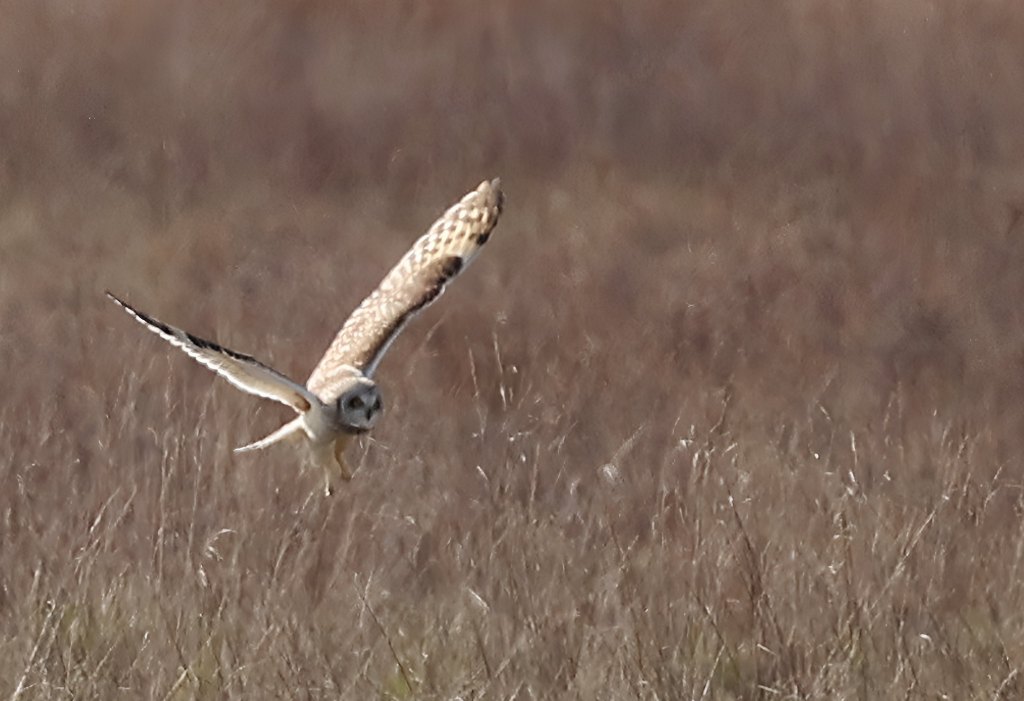
It was about this time that I got a call from a member of the group that had scouted ahead. Two Short-eared Owls were actively hunting the marshes! We picked up the pace, adding a “gulp” of Double-crested Cormorants (yes, their official collective noun), Spotted Towhee, Red-winged Blackbirds, European Starling, and very chittery-chattery Marsh Wrens to the list.
A large flock of Snow Geese accumulated in the farmer’s fields like an accidental bleach spill on a wool sweater. We somehow managed to resist the urge to stop for the geese as we hurriedly made our way to the first of the dyke’s benches. Here, we surveyed the marshes and were rewarded with two beautiful, tawny-colored Short-eared Owls lazily patrolling the reeds for mice and voles. (Further out were Northern Harriers and, dotting the distant shoreline, the occasional hulking silhouettes of Bald Eagles.)
The tide was pretty far out and so while we recognized dozens of Black-bellied Plovers and hundreds—if not thousands—of Dunlin, we couldn’t confidently identify any of the other probable peep species among them (like Western Sandpiper).
About 100-200 meters past the trees and residential homes, we turned around and made a faster journey back to the cars, racking up an easy six kilometers on this truly perfect spring day out. Our total bird list for the outing came to 41 species (see Thea’s eBird list).
Some other honorable mentions include the first few Tree Swallows of the season, American Goldfinches for their beautiful song, and the sole Common Loon that had the good manners to show up to the party in a full black-and-white tuxedo (breeding plumage).
Written by Thea Beckman. Header photo of a Marsh Wren by Pat Smart.
Photos are on Flickr
 Delta Naturalists Society