
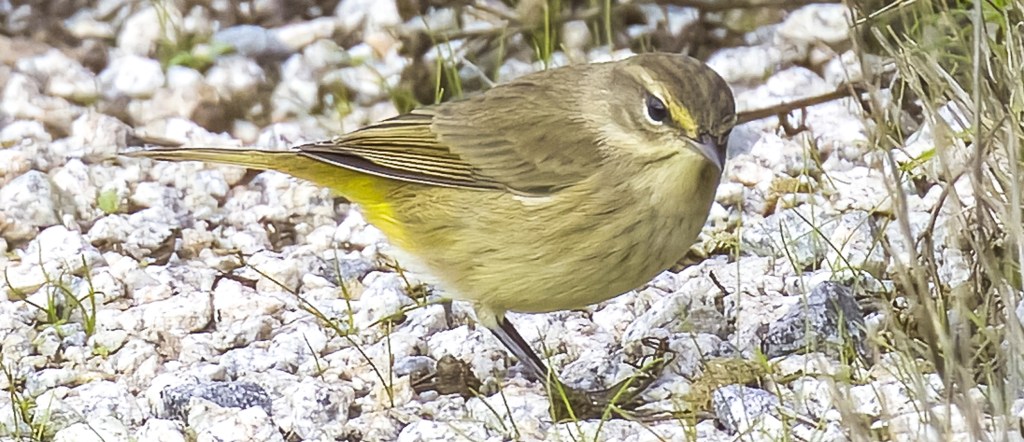
PHOTO: Palm Warbler by David Hoar…….
In the gap between the rains a group of 9 DNCBers met at Brunswick Point.

We were: Liz, Margaretha, David, Christine, Noreen, Colin, Alexandra, Stephanie and Glen. We immediately felt over-whelmed by the flock of X thousand Snow Geese in the field across the road. All morning some of them would lift off, make a racket and settle again, drifting off bit by bit to the waters of the Gulf. En route, we noticed that it was not entirely Snow Geese as we also saw Canada Geese, Cackling Geese and White-fronted Geese. A seal in the river vied for our attention and kept pace for a while as we headed downstream. Some saw a hippopotamus – more on that later.
The bushes had a good assortment of the smaller birds – American Robins, Finches (House, Purple and Gold), and Sparrows (White-crowned, Golden-crowned, Fox, Savannah, Song and a Lincoln’s). At various points along the way the trees added more species – Northern Flicker, American Crow, Black-capped Chickadee, Spotted Towhee, European Starlings and Red-winged Blackbirds. A flock of Bushtits seemed to follow our path, appearing several times as we moved along. There were a lot of Marsh Wrens all along the route, chittering in the reeds along the ditch but never showing themselves enough for us to get a picture.
There were a couple of Northern Harriers floating over the foreshore, diving in to the grasses. At the end of our route, we spotted a juvenile female Harrier perched just off the path with (possibly) a vole in its talons, having lunch. We saw Bald Eagles a few times, though it was probably only 2 in total, one perched above the rebuilt nest at the head of the trail and later two side-by-side on a snag out in the water. We had a good look at a Cooper’s Hawk and there was a (probably) Red-tailed Hawk across the river on top of a barn. While talking about the raptors, we were blanked on the Shrike that is often around. There were a few Double-crested Cormorants flying / swimming / posing and a Caspian Tern alerted us with its distinctive cry as it flew over.
Well after we got around the point we could see a LOT of black dots out in the water. No white dots such as Swans or Pelicans, just black dots. As we got closer, the sharp-eyed few began to pick out Northern Pintail and American Wigeon (suggestion of maybe a Eurasian) in abundance, plus a few Mallards, Gadwall, Northern Shoveler and Green-winged Teal. The fields produced a dozen Killdeer, excellently camouflaged in the dirt and cuttings. Great Blue Herons appeared several times as sentinels in the fields or in a tree or on a snag and squawking as we disturbed their vigil.
There were a few nice additions as we walked back – a Downy Woodpecker in the thicket of Scotch Broom, two Palm Warblers pecking at the trail’s gravel, some Dark-eyed Juncos and two Yellow-rumped Warblers. At the end we had recorded 42 species so that was a good day of birding. We noted that there seemed fewer hunters than usual and wondered if the new location of the parking lot made it too much effort for the hunters to travel all the way out to the foreshore to hunt.
Oh yes, that hippopotamus … iNaturalist suggested that it was probably a Coast Mole, maybe immature, quite naked, quite dead and not yet predated but it sure LOOKED like a just-born hippopotamus!
Report by Glen Bodie
Photos are on flickr
Next Tuesday & Wednesday (Oct 15 & 16) the outings will be to Iona Beach Regional Park in Richmond (via Templeton St & Ferguson Rd).
Meet at 9 am by the washrooms.
To sign up for an outing, click on the DNS bird outing schedule sheet.
 Delta Naturalists Society