
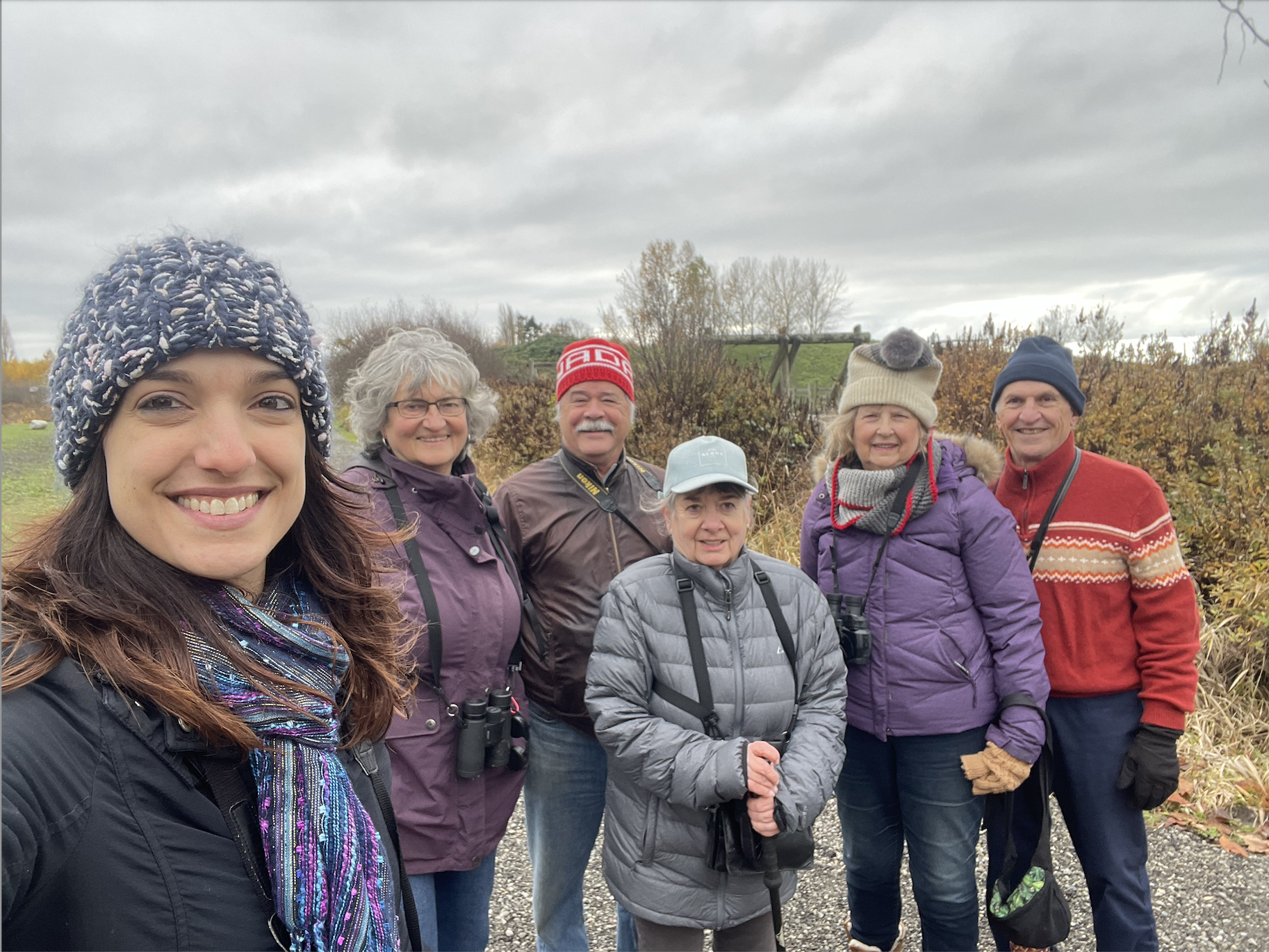
After a real page-turner of a report from the Tuesday group, six Delta Nats—Thea, Rosemary, Richard, Glen, Louise, and Lidia—showed up at Terra Nova practically salivating at the prospect of a buffet of winter rarities, like Redpoll and Pine Grosbeak. The “partly sunny” part of the weather forecast was greatly embellished, and we found ourselves in the teeth of a sustained, icy onshore wind. Anyway, birders are anything but faint of heart, and so we pulled our jackets closer and ventured into the park.
The first wonderful diversion was a “romp” of River Otters (I had to Google that), which crossed the West Dyke Trail, ploughed into the roadside ditch, disturbing a clutch of Mallard, before disappearing into the thick vegetation and into the pond. We literally had to jog alongside the ditch to keep up with them as they sliced through the water and shot through two culverts, following the bubbles and boiled-up mud. Thankfully, we found them again in the pond gorging themselves on fish. Sushi for breakfast!
Backtracking a bit, a Red-tailed Hawk used the powerful onshore breeze to hover above the carpark, scoping out the grass below; the usual mob of American Crow periodically swooped in to remind the hawk whose turf it was on; and both Ring-billed and Glaucous-winged Gull sailed by over the Salish Sea. A Northern Harrier chased up flocks of Mallard and American Wigeon; two American Bald Eagles tittered from the top of the tall pine trees; and a Common Raven lent its much less attractive voice to the morning chorus.
As we made our way into the park, we were a little dubious about our luck for the day. With such an icy wind blowing, surely the passerines would be laying low. But after watching the river otters for a bit—and adding Pied-billed Grebe to the list—we encountered a small mixed flock of Black-capped Chickadees and both Ruby- and Golden-crowned Kinglet. The ascending “weeeee” of Spotted Towhee and treetop warbling of American Robin raised our hopes that the chilly weather hadn’t deterred all songbirds.
Then, we spotted the silhouette of a compact raptor at the top of a tall fir tree. The previous day’s group had reported a Sharp-shinned Hawk, but this little dude didn’t seem to have the right “vibe” for an accipiter (the family of raptors to which Cooper’s and Sharp-shinned Hawk belong). It’s hard to articulate exactly why, but the posture was more “falconesque” and the tail too short. As if to obliterate any confusion, the bird took off and bulleted past us, at which time we were able to get a blurred look at its too-dark plumage (for a Sharp-shinned Hawk) and so we approximated its ID as a Merlin.
We arrived at the community garden hopeful for finches, hummingbirds, and the like and were met with the proverbial sound of crickets. We were surprised to see quite a few vegetables hanging on for dear life; although, we wondered at who the first person was to look at kale and think: “hey, looks edible!” It was exactly at this moment of insulting the kale that we heard a squeaky “ick…ick…ick” call. We looked up, and flying overhead, with the unmistakable rapid wingbeat of a shorebird, was a lone Wilson’s Snipe.
Putting our shorebird savvy to the test, we noticed the incredibly long bill, short neck, and overall size of the bird, which narrowed our choice down to Long-billed Dowitcher and Wilson’s Snipe. (Short-billeds have already flown south for greener pastures.) The final clue was the lack of a white wedge up the back, which clinched the ID of Wilson’s Snipe. (Both species of dowitcher have a white wedge that extends up the back from the rump and is nicely visible in flight.)
Beyond the garden, walking through a grove of pine trees, we added Brown Creeper, Bewick’s Wren, and Pacific Wren to the list. Then, further into the park, we started seeing more sparrows: Dark-eyed Junco and Song, Fox, and Golden-crowned Sparrow. Robins decorated the winterbare trees like Christmas baubles, and we searched tirelessly among them for Varied Thrush (we eventually got one!)
Then we alighted upon a most unfortunate scene. Some individual or organization had either forgotten or intentionally abandoned a bird net, from which three poor birds dangled, so completely tangled up that there was no clear way to liberate them, even with a boxcutter in hand, which a nearby FedEx delivery man had lent to us. Someone—thankfully a bird lover (his name was Shaun—had already come upon the net and had made the necessary phone calls to get the wildlife rescue out. We joined the fray and got to work trying to free two Song Sparrow and a Bewick’s Wren. We eventually got them loose of the main net, but their wings were still terribly tangled up, and had lost so many flight feathers in their desperation that they couldn’t fly.
We packed the three birds into a box supplied by a friendly helper, ripped down the bird net with little regard for its integrity, and dear Shaun took delivery of both: the birds to a wildlife refuge where they could be freed and nurtured until they grow back their feathers, and the nets to God knows where. (Shaun told us that the nets had been abandoned for at least several hours, and judging from the tangled-up condition of the birds, it certainly seemed as though they’d been left there for too long. Ordinarily, bird researchers constantly monitor their nets to ensure that any birds they trap aren’t harmed or stressed. This net had been left for far too long, and we hope the responsible parties get a boot up the behind.)
The funny part of the story is that, right about the time our hands were filled with Song Sparrow, box cutters, and ultrafine netting, Shaun called out: “Hey look, there are the Pine Grosbeaks!” Right about our heads. I briefly considered tossing aside the Song Sparrow to look at the grosbeaks through my binoculars—they would have been a lifter for me—but my humanity prevailed and I made peace with letting them go. They never made it onto the list because the rest of our party never saw them and, frankly, they could have been House Finches for all the details I saw: silhouetted as they were against the gray sky.
Our final excitement for the day was a big, beautiful, woozy-eyed Great Horned Owl, probably the same one seen by Tuesday’s group. Sadly, no Barred Owl, and no Redpolls. We concluded our outing with a total of 34 species: not a bad tally considering the icy wind, and maybe… just maybe… a little positive bird karma for our next trip.
Thea Beckman
Update on abandoned bird nets: Subsequent to the outing, we got in touch with local bird expert Melissa Hafting who, after some sleuthing, determined that it was researchers from Environment & Climate Change Canada (ECCC) who had erroneously left up the nets. Sadly, one of the birds we rescued perished but we did report the incident to the City and Feds, and the city of Richmond and ECCC are taking the matter seriously; following mitigation steps so it won’t happen again. We have the power to protect the birds we love to observe, so make sure you report issues like this or harassment whenever you come across it in the field!
Photos on Flickr
Thea’s ebird report
Next Tuesday & Wednesday (November 28 & 29) the outings will be to
Blaine, USA (Drayton Harbor & Semiahmoo Spit)
Bring passport or Nexus.
Meet at 8:30 at Blaine Marine Park.
Approx 235 Marine Drive, Blaine, WA, USA.
Cross the border at Peace Arch and take the immediate exit 276 for highway 548 into Blaine.
At the traffic circle before the shops, turn right onto Marine Drive, cross the railway tracks and park on the street by the small lookout (across the street from Sundance Yacht Sales).
We’ll look for birds there and at the pier at the end of Marine Drive.
Then we will drive around the bay to Semiahmoo Resort.
Before going to the resort, we will park by the APA museum in Semiahmoo Park (at the beginning of the spit on the left).
To sign up for future DNCB outings go to the signup form and put an x by your name.
 Delta Naturalists Society
Leave a comment