
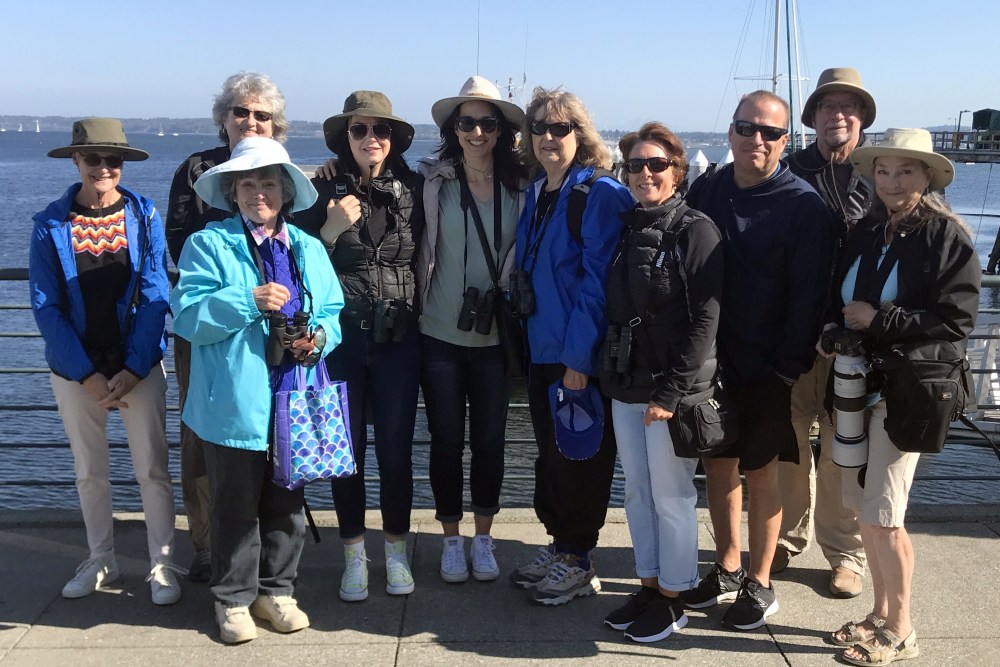
On a day which couldn’t possibly be more perfect, 13 DNS members hopped across the border to Bellingham, Washington, to go on a bird-watching cruise into the Salish Sea. From left to right, they were: Margaret, Lorna, Lidia, Nadine, Thea (yours truly), Rosemary, Nicki, Bruce, Terry, and Pat. Nick, Syd, and Viviane (not pictured) joined shortly after this picture was taken. Our destination for the day was Smith Island—about a 2.5-hour journey southwest—and its colony of Tufted Puffin! Chris and Marlene went on the same trip the previous day.
The usual assortment of common birds was seen about the Bellingham Cruise Boat Terminal, including House Sparrow, Rock (Feral) Pigeon, American Crow, Glaucous-winged Gull, and Pelagic Cormorant. A couple of Great Blue Heron flew overhead on their way somewhere important, and a small flock of Black Oystercatcher performed a fly-by—catching our attention with their insistent piping calls—right before we boarded our vessel; perhaps the same group we saw perched on a pile of large rusty pipes as we came back into harbour 7 hours later.
At 09:45 sharp, we boarded our vessel, the Salish Express, struck up the engine, and glided out into Bellingham Bay. Out to sea, those of us who took up residence on the bow of the boat were buffeted by a strong, invigorating ocean breeze, squinting against the sun’s glare off the water. Before long, we began seeing gulls other than the common Glaucous-winged Gull – but if there’s one family of birds it seems ALL birders have just given up on trying to ID, it’s gulls. I tried in vain to crowd-source an opinion on what they might be, but my questions were mostly met with a shrugging of shoulders. After much deliberation, we landed on California Gull with probably some Western Gull and the odd Ring-billed Gull thrown in.
As a brief aside, while many people find gulls really difficult to identify—provided they aren’t juveniles—adult gulls can pretty quickly be sorted out if you can discern the color of their legs, eyes, and mantle (top of their body). For example, Glaucous-winged Gull have a pale grey mantle, no black on their wings at all, light pink legs, and dark eyes, whereas Ring-billed Gull have a grey mantle, black wing tips, yellow legs, and a pale yellow eye. So, there you have it: the cheat codes to adult gull ID.
The first pit stop on our journey out to Smith Island and our quarry of Tufted Puffin was a rocky outcropping called Viti Rocks, which was home to a breeding colony of Glaucous-winged Gull, Double-crested Cormorant, and Pelagic Cormorant. Harbour Seals littered the base of the tiny island and Pigeon Guillemot paddled the waters around its base.
We then puttered on, slicing between Cypress and Guemes Island, at which point we began seeing impressive flotillas of Rhinoceros Auklet with the odd individual or pair of Common Murre thrown in. It was wonderful to see these sea birds in their breeding plumage. (We also spotted a Turkey Vulture and two Common Ravens scouring the beach of an island we passed by.)
Around 11:30, lunch was served right in time for our approach to Smith Island. Nearing our destination, we disturbed a sizeable flock of Red-necked Phalarope. And then we slowed right down. People crowded the bow of the boat and before long, we spotted our puffins! The waters embracing the island itself were dotted with enormous kelp fronds and, between them, Tufted Puffin, Pigeon Guillemot, and Common Murre paddled, hunted, and dove.
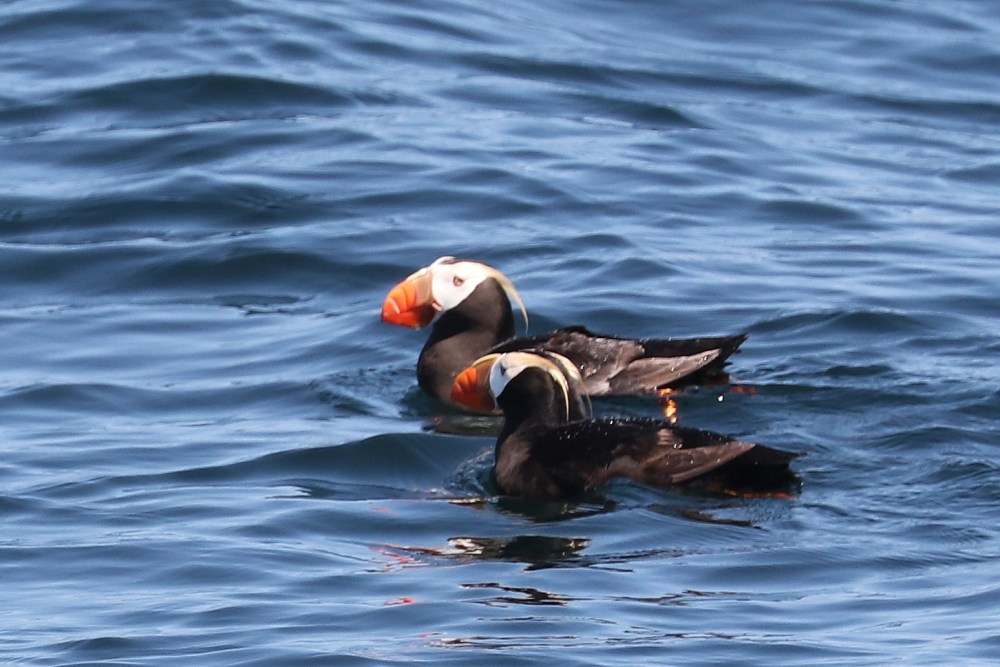
A pair of Bald Eagle have set up shop on the island, which means all they need to do for breakfast is pretty much fall out of their eyrie. Pretty smart! Congregations of gulls indicated shoals of fish and amongst the rabble-rousing flocks of mystery species (with black wing tips) were the gorgeous and handsome Heermann’s Gull, with their sooty plumage, white heads, and crimson bills.
We circled Smith Island and rode huge swells for about an hour, admiring the Tufted Puffin and hoping for the elusive Horned Puffin that had been seen here in recent days but, alas, to no avail. (At least nobody lost their lunch.)
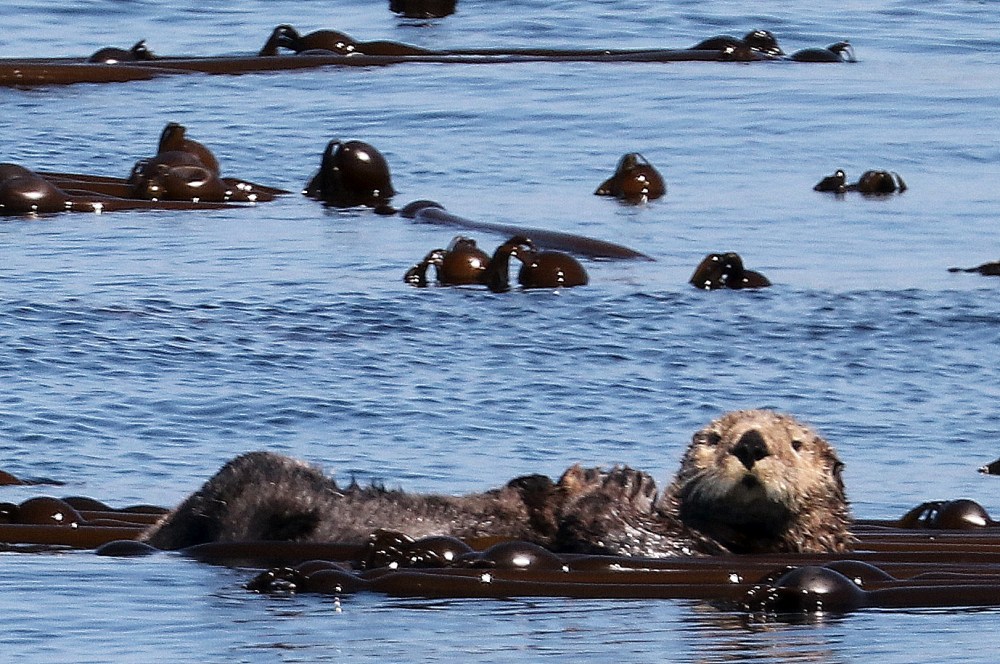
Our final island drive-by for the day added one new bird species to the list—Black Turnstone—but the real star of the show was a sea otter, which floated on its back and busied itself enormously with its paws.
The boat ride back was pretty uneventful and the rhythmic rising and falling of the vessel lulled several of the group to sleep. We were a little disappointed to have not seen any other marine mammals like porpoises, orca, and other whales but, you know, nature viewing is always a crapshoot. Besides, a day on the water in the fresh sea air, with spectacular views of fir-forested islands shooting by… well, it’s hard to be disappointed for long.
We arrived back at the ferry terminal at 5 PM and were back in Delta shortly after 6 PM, with pretty short lines at the border.
Now, who’s up for a pelagic trip?
Thea Beckman
Photos are on Flickr
Photos by others will be added later
Thea’s eBird list
 Delta Naturalists Society
Leave a comment