
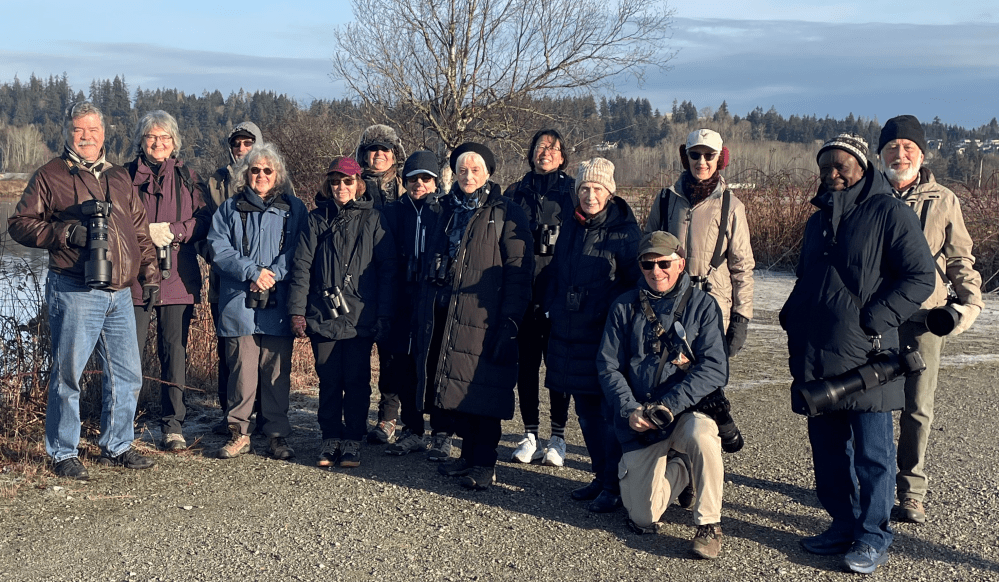
With high-level clouds above the eastern horizon catching fire with the rising sun, it was hard not to feel like a bear emerging from hibernation after a long, gloomy winter. 14 Birders met in the King George parking lot at Serpentine Fen: Thea (yours truly), Brian & Louise, Colin & Stephanie, David & Noreen, Glen, Jonathan & Lorraine, Lidia, Lindly, Jacquie and her friend Anne, who joined us from Port Hardy. (Margaretha and Lee caught up with us a little later on.)
Right away, there was plenty of action to keep us occupied while we waited for everyone to arrive. The skies bustled with traveling parties of Canada Geese and Cackling Geese, the latter, much smaller species passing over in large, dishevelled skeins; there was a fleeting commotion as two Red-tailed Hawks pursued a Bald Eagle; and the promised female Belted Kingfisher perched on the powerline, surveying the water as it passed beneath the bridge.

A handsome male Common Merganser hunted the central waterway, while Mallard, American Wigeon, and Green-winged Teal huddled closer to the grassy banks. I don’t blame them. It was bitingly cold and the ground was gripped—almost locked solid—in frost.
As we made our way slowly up the river, we added more duck species to the list, including Gadwall, Common Goldeneye, Bufflehead, and Greater Scaup. Large flocks of European Starlings, American Robins, and Red-winged Blackbirds dotted the tops of the winter-bare trees bordering the pathways, while Great Blue Herons stalked the river’s shores.

Overhead, there were Glaucous-winged Gull, our familiar large gull species with crisp all-white underwings, pink legs, and dark eye. But scrutinizing the other gulls flying over periodically revealed two other species: Ring-billed Gull (black wing tips, yellow legs, bright yellow eye, and ring on the end of its bill) and Short-billed Gull (similar to afore-mentioned but with a dark eye and noticeably short, stubby bill).
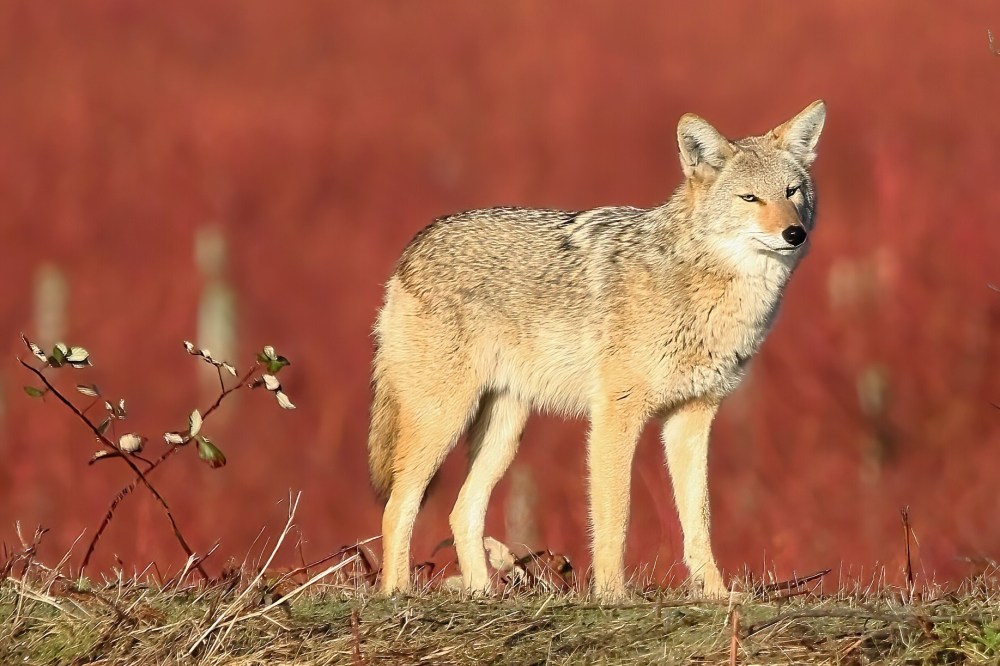
Alas, gulls don’t tend to get birders hot under the collar, but what certainly does is Northern Shrike and lucky for us, one perched right at the top of a bare tree, just across the river from us, perfectly content to bask in the sun while we eyed it with our binoculars. And not very far from the shrike, a gorgeous specimen of a Coyote had the same idea. The animal lay on the path on the opposite shore, got up, flopped down, got up again, and then executed a long, languorous stretch, while we looked on in amazement. (We see your Townsend’s vole and raise you a coyote, Tuesday group.)
At the first watch tower, we saw our first Eurasian Wigeon, albeit in the distance and buried deeply in a larger flock of its American cousins. There was also a small flock of Northern Pintails huddled underneath the tower and, in the section of river beyond, one or two Lesser Scaup, with clearly peaked head. Song Sparrow and Red-winged Blackbird were vociferous, and we saw quite a few Spotted Towhee popping in and out of the brambles on either side of the path.
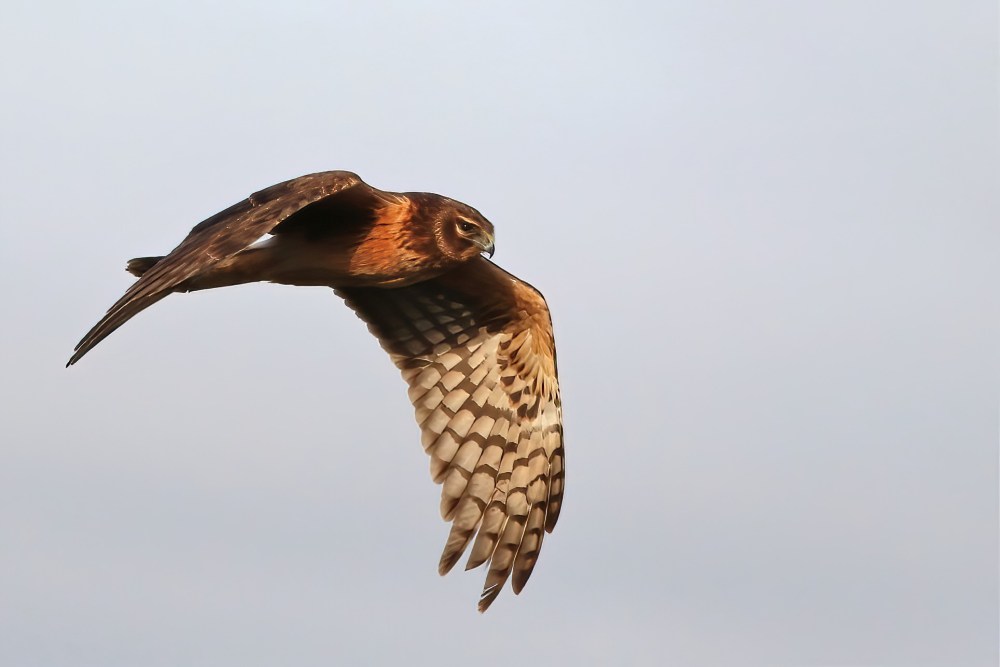
At the second watch tower, the ponds bustled with waterfowl and we added Northern Shoveler, Ring-necked Duck, and American Coot to the list, as well as a female Northern Harrier who patrolled the marshes right in front of the tower. An enormous flock of American Wigeon grazed on the opposite side of the path and if you searched them thoroughly, you’d unearth the occasional Eurasian Wigeon, like gemstones suspended in ore.
Our final (and crowning) achievement for the day was what we—and I—are almost entirely certain was a Great Horned Owl. Suddenly, a flurry of movement caught our attention. An owl zoomed quickly over our shoulders to be lost to us forever in the thick vegetation beyond. Its large size, heavily speckled feather coat, and coloration that tended towards grey convinced me it was a Great Horned Owl. Typically, these birds are perfectly happy to stare down at you from their lofty vantage points, with faces like angry cats. This one must have felt vulnerable and so decided to beat it.
The walk back to the cars was done with a little more haste in an attempt to get the blood circulating back into our frost-bitten toes, but we did manage to add a few final species to the list: Golden-crowned Sparrow, Bewick’s Wren, and Cedar Waxwing, bringing our total for the day to pretty decent 37 species!
Tragically, on the way home, David and Noreen found a dead Barn Owl that had been struck by a car. They noted that it was banded and so dropped it off at OWL Rehab, who will send it to the appropriate government department.
Thea Beckman
Photos are on flickr
Thea’s eBird List
 Delta Naturalists Society
Leave a comment