
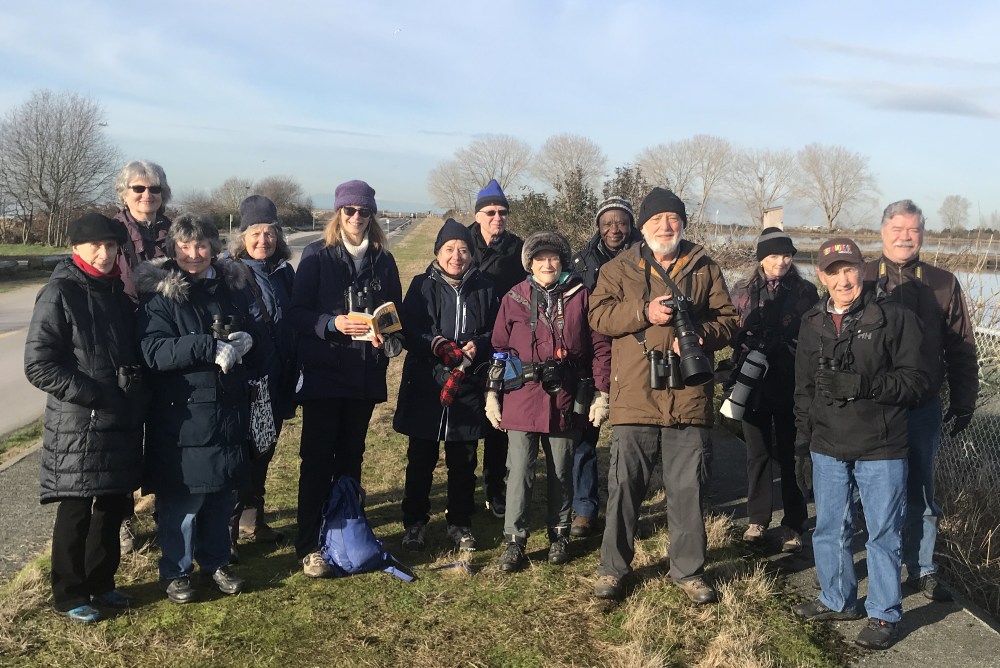
Fourteen birders met at Iona Regional Park on a gorgeous sunny morning – Lorraine, Lidia, Lorna, Jacquie, Lee, Louise, Nick, Marion, Jonathan, Brian, Pat, John, Glen and Terry. Margaretha joined us at toward the end to make 15. The Tuesday outing had been cancelled because of heavy rain.
There were no birds at the beach. The few ducks in the South Pond were hard to identify because we were looking into bright sunshine. We later identified them as Lesser Scaup, Bufflehead and American Coots. Noisy Red-winged Blackbirds were everywhere. We soon added Song Sparrows, Spotted Towhees, House Finches, Great Blue Herons, Black-capped Chickadees, American Robins, Marsh Wrens, Bald Eagles and Crows. We were pleased to see that some of the reeds had been cut back to give views into the North Pond. But there were no birds on the water. Huge flocks of Snow Geese flew overhead.
Since the inner ponds are permanently closed, we walked along the fence to the road where we could look into the ponds. A Northern Shrike appeared long enough for a photo. There were large numbers of ducks on the ponds, but of course they were near the far shore. In the first pond were mainly Northern Pintail. In the second pond were mainly Lesser Scaup. But we did see Ring-necked Ducks and a Ruddy Duck as well.
We walked back along the fence to continue our usual route along the river. Here we added Northern Flickers, Golden-crowned Sparrows, Anna’s Hummingbirds, Ravens and Fox Sparrows. Back at the South Pond we heard a Virginia Rail.
Since we were in Richmond, some of us went to the dyke at the end of Williams Road to look for the Sora. Some of us gave up after a short wait. Glen reports that after 20 minutes it popped its head out for a second, turned around, and disappeared back into the bush – and never came back.
Terry Carr
Photos on Flickr.
Brian’s eBird checklist.
Addendum: Glen’s Mushroom Report
On the trails around Iona Beach Park today everyone was very helpful pointing out mushrooms they saw along the way. Three of them are described below. There was one other – a puffball. It had pretty much finished its life cycle (Jacquie said it was too far gone to be worth kicking!) but we did manage to puff a few more small clouds of spores out the top!
#1 was on an old stump of a shrub along the riverside trail (thanks Terry), sandy soil, no spore print taken, stem was very flimsy/hollow. It seems to be another LBM (Little Brown Mushroom) and my best guess is that’s another Tubaria species, very common this time of year, lots of variety of appearance.

#2 was in an old fallen log as we returned to the beach (thanks Lee), sandy soil, thought they were growing right on the wood but you can see that they have quite a long thin stem, they were very fragile, no spore print taken. These seem to be in the Xeromphalina campanella group, also called Fuzzyfoot.

#3 was a small cluster growing in the grass near the bird banding hut (thanks Marion), sandy soil, note the white tip of the stem and the blunt gills, no spore print taken. It is most likely an Entoloma, maybe E. sericeum. I should have taken a sample to spore print since these are supposed to have pink spores!

 Delta Naturalists Society
Leave a comment