

We may not have had the weather on our side for our first Saturday outing in many moons but in spite of the pendulous cloud-cover and, later, relentless rain, an impressive party of 22 birders gathered at Centennial Beach on the morning of January 7th. And for our bravery, we were treated to a rather extraordinary day of bird-watching!
Attendees from the Delta Nats included Bruce, Nicki, Chris, Christine, Douglas, David, Noreen, Peter, Susan, Mary, Karen, her husband, Rosemary, and Thea, your intrepid leader. And a special welcome to non-members Derek, Herb, Sunny, Sagnik, Douglas Bamford, Colin and his two sons Cole (11) and Arthur (8), all of whom, I am hoping, had a good enough time to consider joining the DNS!
At 09:10, with everyone present and accounted for, we struck out; although there was plenty of birding to be done in the car park itself: three pairs of Bald Eagle dotted the embracing winter-bare trees; a skein of 30+ Snow Geese flew overhead, the first and last we’d see for the day; and dozens of American Robin patrolled the lawns for breakfast (with one European Starling hanging out among them). A flock of Brewer’s Blackbird patrolled the park, and a noisy group of Red-winged Blackbird filled the air with their robotic yammering. /image

Brewer’s Blackbird by Chris McVittie
The nearby pond was dominated by American Wigeon, with several pairs of Mallard nestled into the reed beds on the far shore. But duck ponds are often a bit of a “lucky packet”, so if you pay attention and search thoroughly, you’ll come up with a few gems, and today’s pond gems were a single male Northern Shoveler, female Common Goldeneye, and what was either a leucistic Mallard or a Mallard x domestic cross.
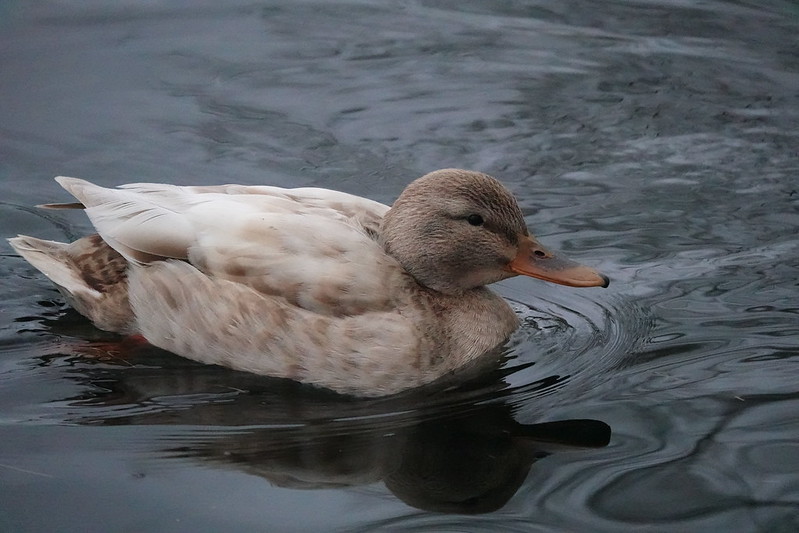
Leucistic Mallard / Mallard x domestic hybrid (Photo by Chris McVittie)
Earlier that morning, there was also a lone Eurasian Wigeon in the pond, but by the time we got there with the group, it was nowhere to be seen. Perhaps tucked into the reeds or wandered off with a flock of grazing wigeons.
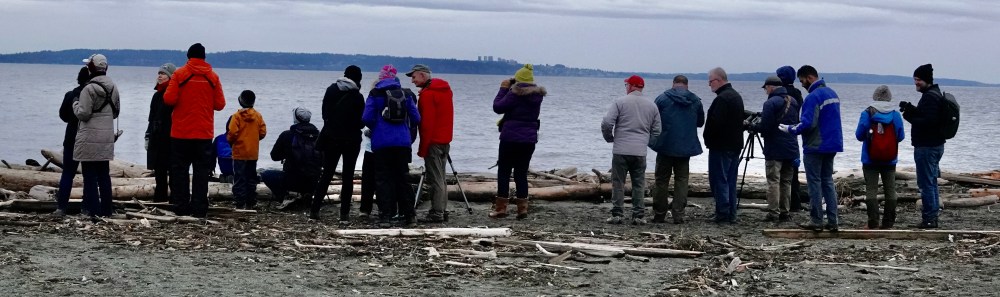
Photo by Chris McVittie
We then headed for the shore to scan the steel-grey ocean water for sea birds and diving ducks, and we weren’t disappointed! A raft of Surf and White-winged Scoter were close enough to the shore for us to tell the species apart, but also to discern a decent-sized flock of Greater Scaup mixed in with them. The water was fairly choppy, which made spotting grebes and loons a little tricky but, even so, our large group’s eyes (in particular the youthful eyes of our two young birders, Cole and Arthur) picked out a few surprises. The first was a Western Grebe and a Red-throated Loon (a lifer for me!), whose slim, slightly upturned beak immediately aroused suspicion and, upon closer inspection, revealed its surprising ID.

Red-throated Loon (image by Bruce Taylor)
We succeeded in adding a Horned Grebe to our list before shuffling off across the damp sand in the direction of the location a Townsend’s Solitaire had been spotted earlier that morning.
En route, we found Spotted Towhee, Anna’s Hummingbird, Song and Golden-crowned Sparrow, Black-capped Chickadee, and always a nice surprise, Purple Finch. If you ever needed an ID “hack” for telling them apart from House Finches, look for the white supercilium (eye stripe) in the females and lack of streaking on the breast in males.
Before long, we found the Townsend’s Solitaire—an all-grey, robin-sized bird with white tear-drop eyes and white wing bars—flitting about in the Washington Hawthorn. This was a lifer for many people in our party, so we spent a few good minutes admiring this (somewhat) rarity.

Townsend’s Solitaire (Photo by Chris McVittie)
At this point, the weather had gone from threatening to downright insulting, and great fat drops of rain started to fall. Our party adjusted our rain jackets and forged ahead in the direction of the pumphouse. Here, on a sandspit, we were treated to perhaps the most fruitful birding spot of the day.
Great flocks of Canada Geese paddled in the shallows, and in the process of scanning them for smaller Cackling Geese, we discerned a lone female Bufflehead and a male Ruddy Duck in non- breeding plumage.
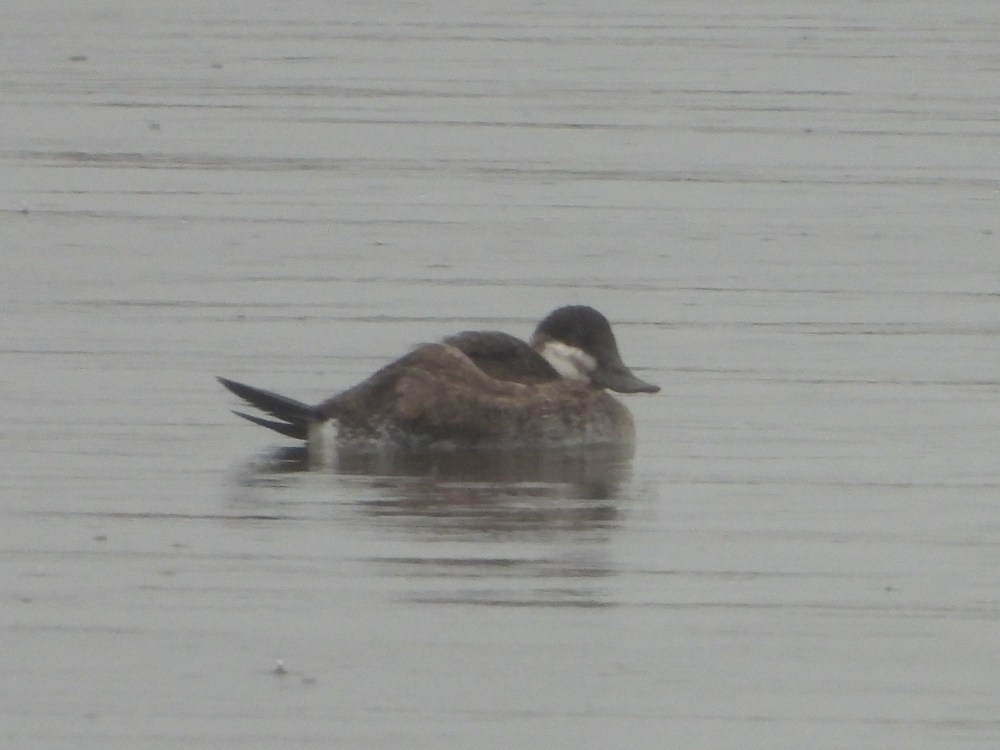
Ruddy Duck (Photo by Bruce Taylor)
Glaucous-winged and Ring-billed Gulls cluttered the spit, while Greater Yellowlegs and flocks of Dunlin probed the water’s edge for small invertebrates. A decent-sized flock of Brant clustered at the northmost end of the spit and, looking closely, we also spotted Northern Pintail and Greater Scaup.
On the other side of the path were several Gadwall inhabiting the marshy grasslands. Further on, a mixed flock of Sanderling and Dunlin skittered along the shore like marbles on a waxed floor.
At this point, we were soaking wet and so we headed back to the car park with a decent 40 species on our list (check out my eBird list here) and a few new lifers, as well as friends. And as if to bid us farewell, Centennial Beach threw us a Red-tailed Hawk and Northern Harrier on the way out.
Thanks everyone for joining!
Thea Beckman
More photos on flickr.
 Delta Naturalists Society
Leave a comment