
On Thursday November 10, Thea, Rosemary, Jonathan, Lorraine, Terry, Bryan, Janet, Estelle, and Lorna plunged south in the predawn gloom on a day trip to Port Townsend in the United States. Lidia overnighted in Coupeville and met us at the Keystone Ferry Terminal, so there were 10 of us in total.
The day dawned overcast with fluffy-mid-level clouds smeared from horizon to horizon. As we drew closer to Whidbey Island, the thick Washington forests and occasional urban center opened up into rolling farmlands dotted with ramshackle barns and tool sheds. To the southeast, the Olympic Mountains were drenched in the sun’s champagne light. Some of the birds spotted en route included the usual European Starlings, blackbirds, and utility pole-stationed Red-tailed Hawks, but also an American Kestrel, which I saw on a road-side powerline overlooking a field.
Just past Burlington, a field was painted white with a large flock of stately Trumpeter Swans, one of the 10 largest birds in the world. There were also what looked like Canada Geese mixed in, but we were zipping along in an effort to get to the ferry in time for our 10:15 ride, so we didn’t stop to investigate.
We arrived at the Keystone Ferry Terminal with an hour to spare, so we checked out the surrounding shoreline and neighboring Crockett Lake. A telescope would have been a useful implement for the sea birds and ducks that dotted the distant waters on the lake, but some imbecile (me) accidentally left said implement in the boot of her car. In spite of being optically challenged, however, we managed to identify scores of handsome male Buffleheads, and their less flashy female counterparts. A Great Blue Heron hunted the lakeshore; a flock of Northern Pintail Ducks came in for a landing; and, later, some of us spotted a Northern Harrier patrolling the marshes.
In the deeply-scalloped bay itself, from where the ferry launches, there were Glaucous-winged Gulls and Killdeer on the pebbled shoreline, and a pair of Pigeon Guillemots and a Common Loon paddling between the wooden pylons. On the ocean-facing shoreline, adjacent to Keystone Spit, a large wooden structure housed a colony of Pelagic Cormorants with a handful of Double-crested Cormorants thrown in. We scrutinized each individual, but sadly we didn’t discern any Brandt’s Cormorants.
I made it a personal mission to identify some of the gulls flying about and one in particular, in the water next to the cormorants, looked curious to me. It had a light-to-medium gray mantle, dark pink legs, and a medium-sized yellow beak with a red dot. It didn’t have the heft of a Glaucous-winged Gull, and so I figured it to most likely be a Thayer’s Gull. I didn’t put it on the list because I just wasn’t certain, BUT I do believe that, as a birding group, we should start to brush up on at least our adult gull ID. So, to that end, here’s a really useful (and uncomplicated) “cheat sheet” for adult BC gulls!
eBird: Port Townsend-Keystone Ferry (Island Co.)
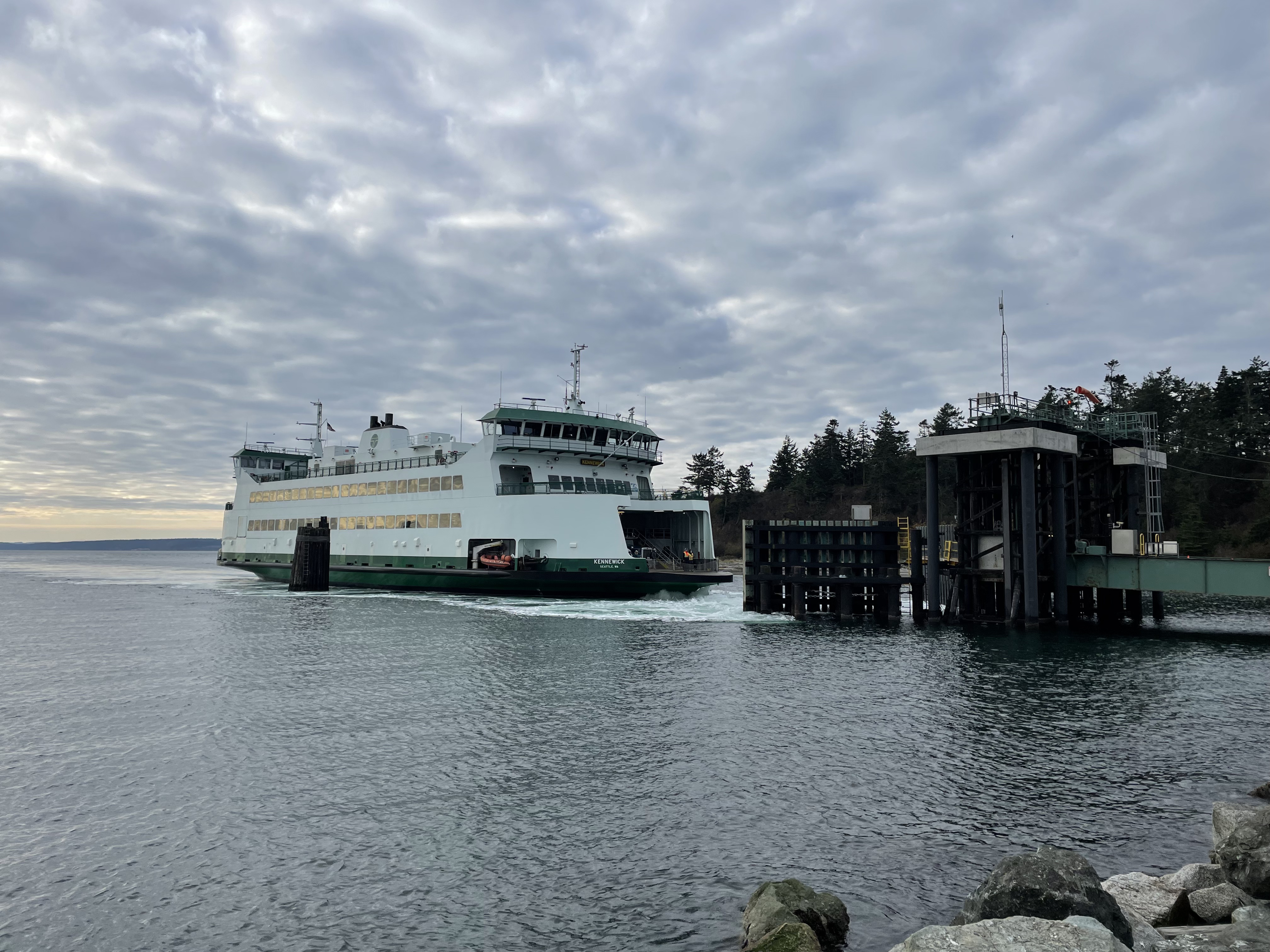
Our sweet chariot arrived bang on time and on the trip itself out to sea, all of us braved the biting cold to stand out on deck and bird. And we were rewarded for it! The ship disturbed Surf Scoters, White-winged Scoters, Common Murres, Pigeon Guillemots, Rhinoceros Auklets, and a Red-necked Grebe as it puttered its way across Puget Sound. There must have been a shoal of fish (or several) because there were also hordes of gulls going crazy in concentrated flocks, and amongst the larger species, we spotted a much smaller Bonaparte’s Gull.
30 minutes later, we arrived at Port Townsend more than a little ready for a warm beverage and an (early) lunch. By 11:30, we were refuelled and back on the road. Our first stop was the Point Hudson Marina where, right away, we encountered a rather unusual sight: a single Snow Goose and Cackling Goose had forsaken their flocks to hang out here, together, because I guess migrating is a pain in the tail feathers. The two seemed perfectly content to graze on the grass and pretty much ignored our presence. The marina was also home to a talkative Belted Kingfisher, which is always a pleasure to see.
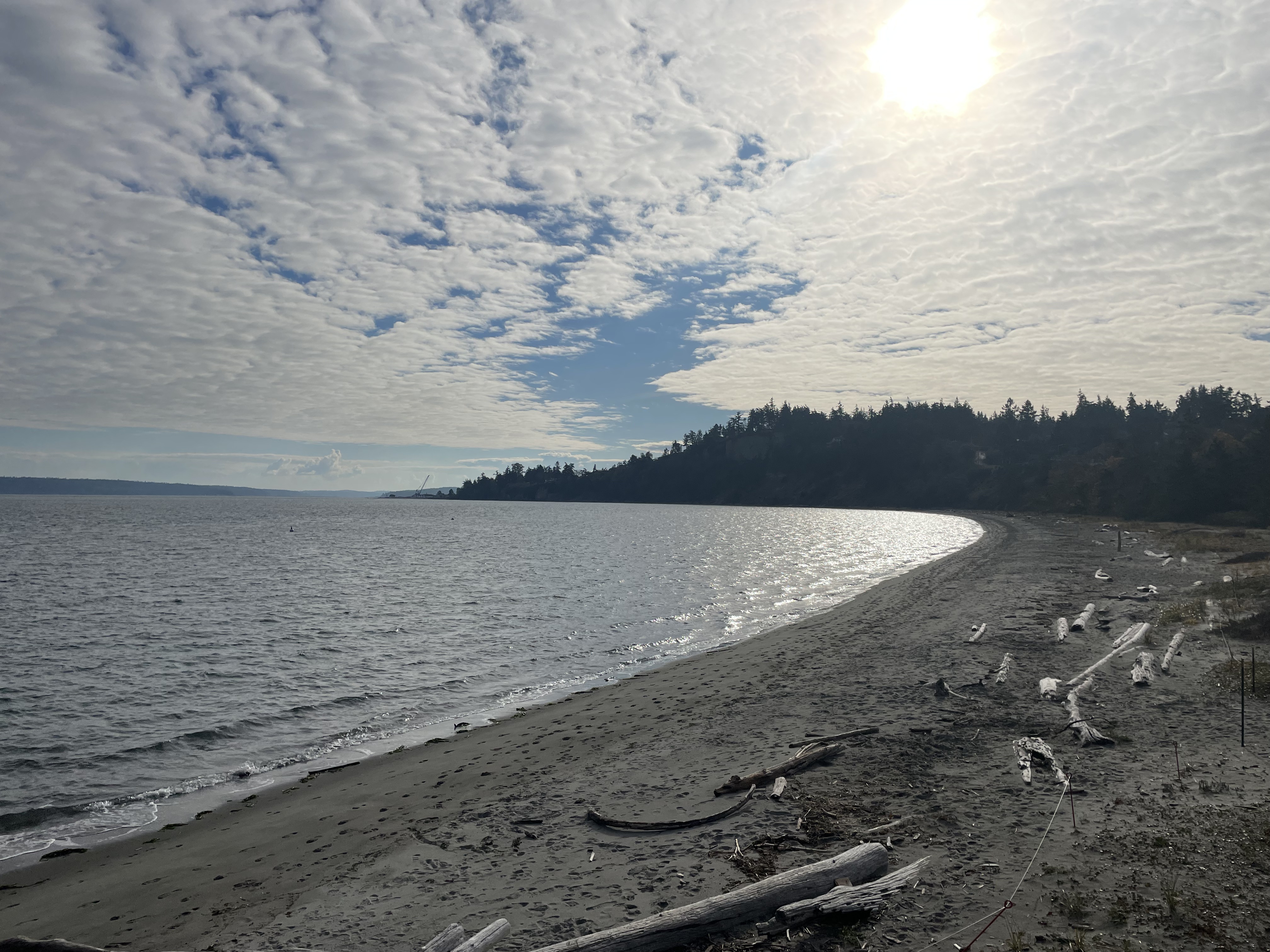
On the adjacent coast, a cluster of Glaucous-winged and Short-billed Gulls were chilling on a sandbar. Further out, Buffleheads, Common Loons, both species of scoters, and, surprise, a small flock of Western Grebes bobbed up and down in the choppy waters. We also discerned a female Common Goldeneye, sneakily hanging out with the Buffleheads. Double-crested Cormorants and Red-breasted Mergansers whizzed by.
Further up the coast at the Port Townsend Marine Science Center, we added a Red-necked Grebe to the list, and got beautiful close-up views of Short-billed Gulls riding the sea breezes close to the wooden walkway.
American Robins, Northern Flickers, House Finches, Dark-eyed Juncos, White-crowned Sparrows, Golden-crowned Sparrows, and Spotted Towhees flitted about the thickly vegetated, ocean-facing cliffs on the other side of the road. At the top of a tall conifer, a Varied Thrush with obvious black breast band and orange throat posed for a precious minute before taking off. And just as we hopped in our cars on the way to the Point Wilson lighthouse, two Common Ravens circled high above the cliffs.
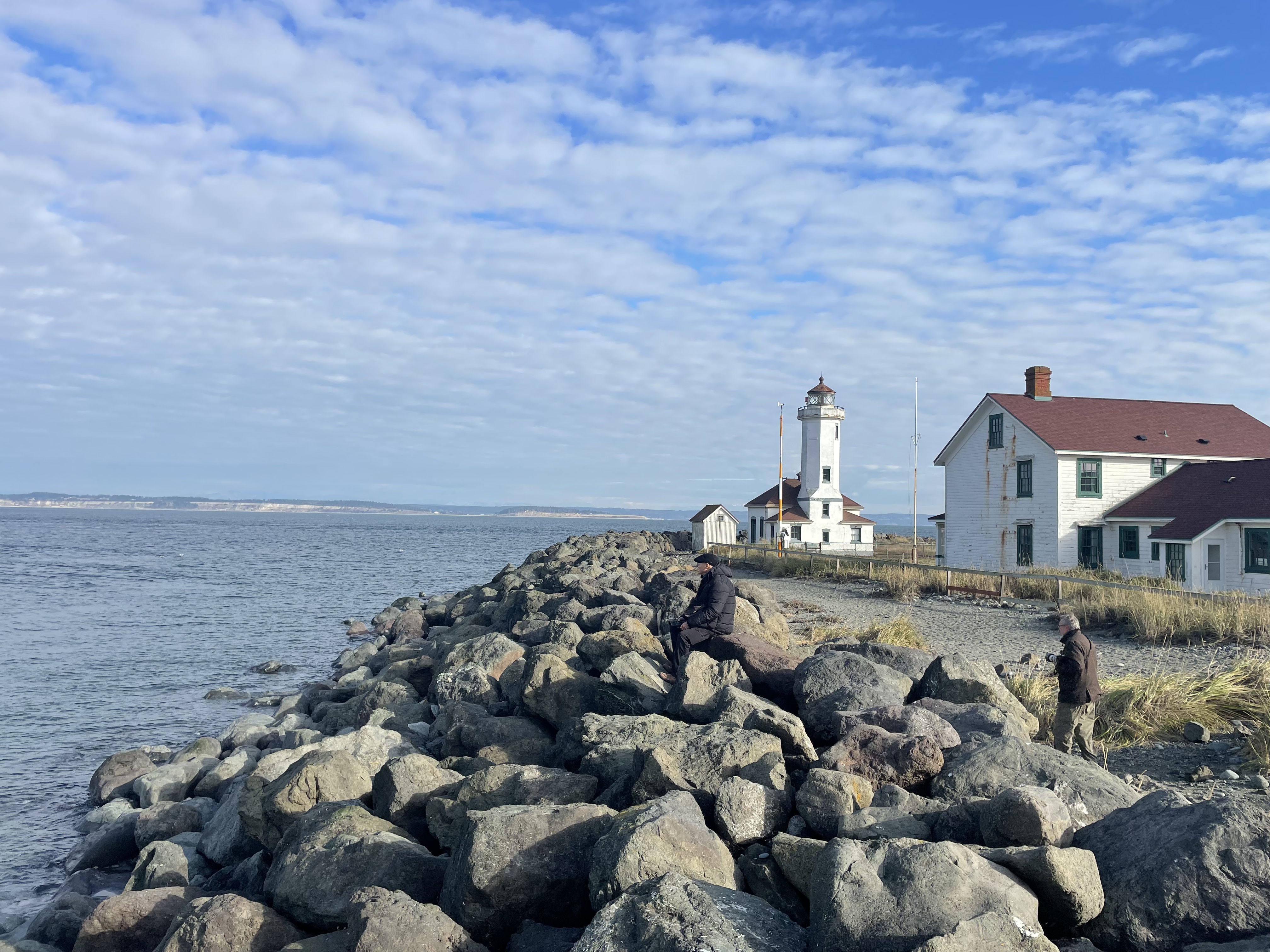
At the lighthouse, a shoal of fish out to sea attracted several gull species, and it was here that we identified what Rosemary, Jonathan, Lorraine, and I agreed to be the “bird of the day”. It began with a blurry shot on Jonathan’s camera: zoomed in, some of gulls, which we at first took to be juveniles, appeared to have bright red beaks. And you know what that means? Heermann’s Gulls. We also identified Bonaparte’s Gulls and added Horned Grebes to the list.
eBird: Port Townsend Marine Science Center
Our final stop for the day was Kah Tai Lagoon, which not only yielded a boon of duck species out on the water, but also passerines in the embracing foliage. There were dozens of American Wigeons and Mallards, with spectacular male Hooded Mergansers dotted throughout. Scrutinizing the flocks carefully, we weeded out one or two Gadwalls, Northern Shovelers, and Common Goldeneye. There were also several Pied-billed Grebes and a surprisingly large concentrated flock of American Coots.
A Belted Kingfisher attempted to evade us as we skirted the edge of the lagoon, taking off as we neared, only to land a little further down. The activity to our right, away from the lagoon and in the park itself, was even more remarkable. The trees were practically alive with skittish Yellow-rumped Warblers, Cedar Waxwings, and Golden-crowned Kinglets. Both Black-capped Chickadees and Chestnut-backed Chickadees flitted in and out of the trees, the latter hanging upside down from pine cones, showing off their rich russet mantles.
eBird: Kah Tai Lagoon
With the afternoon wearing on, we wrapped up our birding and headed back to the ferry terminal for the 3:30 sailing. Here we watched a pair of Bald Eagles hanging out on the radio tower of an out-of-operation ferry. After such an early start, the drive back felt long with much of it spent in darkness, but my gratitude goes out to the drivers who took on the task and to Terry for organizing such a wonderful day out!
Thea Beckman
Photos on flickr
 Delta Naturalists Society
Leave a comment