
The following report was compiled by Thea Beckman as a personal account of the DNCB’s field trip to the Okanagan. As such, a personal perspective is used in the story-telling and the determination of birding highlights, list-keeping, and identification criteria. Should you have any questions, contact Thea directly at thea.beckman@gmail.com

DAY 1—Manning Park Resort & Beaver Pond trail
As birders (and photographers of birds) our hobby is one characterized by long periods of struggle—patiently hunting our quarry—punctuated by moments of victory during which we finally see and possibly capture on film a new bird. We’ll stalk the deep bush, scouring the dense foliage, chasing brief flits of movement, while teased by rich melodies so nearby SURELY it has to be right there… right? It’s the struggle we love.
But then there are those birding experiences, like Manning Park Resort, where one is greeted by gangs of Clark’s Nutcrackers and Steller’s Jays milking enthusiastic tourists for their bread, and all you have to do is sit back and watch the wildlife strike exuberant poses within arm’s length all around you.
This is how our party of 20 birding enthusiasts kicked off our grand bird-watching adventure into the Okanagan: with a brief stop at the resort, where we soaked up a buffet of Corvidae (including a Common Raven, which brooded high up in a tree overlooking the scene below). Fun fact: We all know that crows, jays, and magpies, etc. are pretty smart birds, but did you know that specific members of the family have demonstrated self-awareness in mirror tests and tool-making abilities?


Other birds (easily) seen about Manning Park Resort included Violet-green Swallows—which seemed to be nesting under the eaves of the main lodge—Brown-headed Cowbirds, a small flock of Pine Siskins, Dark-eyed Juncos, and the ubiquitous American Robin, which also goes by the moniker: “JUST a robin.”

From here, we drove 400 meters down the highway to the Beaver Pond Trail, which had become so overgrown, with parts totally washed away, that it was basically impassable, thanks to drunkenly leaning and fallen trees. However, in spite of the state of the trail, the birdlife was abundant and melodiously singing its heart out.
Song Sparrows and Common Yellowthroats lent their voices to the morning choir (we saw them too). Numerous vocal Yellow-rumped Warblers and Townsend’s Warblers flitted within the boughs of the trees, even treating us to decent sightings.


A male Rufous Hummingbird sat like a polished garnet jewel at the highest point of a sapling fir and nearby, perched at the tippy tops of long-dead bare trees, were two largish flycatchers. With their dark plumage and handsome vests and crests, we decided they were Olive-sided Flycatchers. A Warbling Vireo laid down a sweet tumbling soundtrack of music and those who were quick with their binoculars would have caught the creamy, lemon-colored bird flitting and dangling upside down in the boughs overhead. Not to be outdone, Western Tanagers were also singing brightly, and Chris’s quick eyes found a pair hanging out in a pine tree.

A few intrepid birders braved a particularly unkempt arm of the trail, climbing over and under fallen trees in pursuit of a woodpecker that had been heard drumming against a tree. If we had been back in Vancouver, we may have declined the challenge. But being in new territory, with the prospect of new interesting species of woodpeckers, it made a few scrapes and bruises worth the risk. Two of us were rewarded for the effort—Terry and yours truly—with a brief yet definitive sighting of a Red-breasted Sapsucker.
We left Manning Park and Beaver Pond trail with a decent total of 18 species, a most excellent start to our grand Okanagan adventure!
Manning Park Resort eBird List

Kobau Regional Park & Ginty’s Pond
We arrived at Kobau Regional Park in Cawston right on time for lunch. Too excited to sit down to eat, I inhaled my sandwich and immediately began my next eBird checklist. Peeping from a nearby fruit tree were House Sparrows, and numerous Eurasian Collared-Doves—somehow marked as “uncommon” for the area—called from the surrounding trees.
We heard and saw Western Wood-Pewees, the call of which we briefly confused with Common Nighthawks, which were also seen flying overhead by some of our party. A Steller’s Jay harassed a small flock of Cedar Waxwings, and some reported seeing a Gray Catbird, a slatey-gray, robin-sized bird with a comical black cap and the sweetest jumbling song and occasional wailing calls, resembling a cat’s meowing.

Two California Quails were seen further along the gravel trail. Willow Flycatchers teased us with their “whee-wheeo” calls but eluded our binoculars. At the end of the path, which just kind of runs out into the creek, we saw Red-winged Blackbirds, Yellow Warbler, and Black-headed Grosbeak. Merlin Sound ID app strongly suggested a Lazuli Bunting was calling (and I verified that with my own ears) but we just didn’t see the bird, so it didn’t make the list for this particular stop on our itinerary.
An Eastern Kingbird did a flyby just long enough for me to see it (and NO-ONE else so you’ll have to take my word for it). Dark on top, white below, diagnostic white tail tips, and a most peculiar flight style with shallow, rowing wingbeats and a raised head. A gorgeous Black-billed Magpie flashed its striking plumage—long tail trailing in the breeze—at the top of an enormous pine. Two juveniles (or females) with shorter tails hung out demurely in a path-side bush.
The highlight of this excursion for me were two Lewis’s Woodpeckers, which at first mystified us with their unusual ambling flight and flycatcher-like behaviour. In reading up about them afterwards, I learned that they do indeed have “flycatching habits” and a “crow-like flight”. Another highlight was a brightly-colored Bullock’s Oriole, which blazed a rich, red-orange color against a backdrop of green leaves, impossible to miss once you’d been alerted to its general presence in a tree across the creek.

Kobau Regional Park eBird List
From Kobau Regional Park, we drove a short distance to Ginty’s Pond, which was really just a verdant expanse of reeds dotted with Red-winged Blackbirds. On the way there, however, Colin reported flushing out two Common Nighthawks which had been sleeping on the road. While I didn’t see the actual flushing, I did see what looked like three impossibly large swifts swooping and diving in the sky overhead (with white racing stripes on the undersides of the wings) and realized they were the nighthawks we’d been hearing!

A dark flycatcher perched on a power line above our heads giving us plenty of opportunity to identify it and after considering its upright posture, lack of eye-ring, and long primaries that extend past the body, we settled on the ID of Western Wood-Pewee.
As we were heading back to the cars ready to depart for our final destination for the day—the Coast Oliver Hotel—a pale Empidonax flycatcher and a hummingbird made an appearance. I didn’t get a good look at the former, although Marion is of the opinion that it could have been a Dusky Flycatcher (photos anyone?). As for the hummer, it had green iridescence on its back, a pale wash of rusty rufus on its sides, and the beginnings of bright display feathers under its chin. If I were in Vancouver, I would have logged it as a Rufus Hummingbird, but since there was now the possibility of Calliope hummers, this little critter went without a satisfying ID. You win some, you lose some.
Coast Oliver Hotel & Okanagan River
After a rather gut-wrenching half-hour drive along steep cliffs and slippery gravel roads from Cawston to Oliver—one of “Roger’s famous short-cuts” apparently—we checked into our hotel around 4 PM and with a room overlooking the Okanagan River, I immediately went to work identifying the abundant birdlife outside. A small flock of American Goldfinches perched in a bare tree outside my window; Cedar Waxwings raced to-and-fro, chasing bugs; a pair of Mallards flew overhead; and, in the distance, with the hazy bulk of Baldy Mountain as backdrop, a Turkey Vulture wobbled by.


That evening, a group of about 10 of us went for a walk along the Okanagan River, which proved to be a rich and rewarding excursion, as tired as we all were from the day’s thrills. As soon as we exited the hotel’s doors, a very small, sickle-winged raptor whizzed by overhead, being chased by smaller birds. By process of elimination—too small to be a Cooper’s Hawk or Peregrine Falcon, and just not the right shape or color for American Kestrel—I arrived at the opinion that it was a Merlin.
The river ecosystem is clearly a favourite of fast-flying aerial birds, with THREE different species of swallows seen slicing through the air up and down and across the water: Violet-green, Northern Rough-winged, and Barn Swallows. With such frantic activity all around, one could be forgiven for not noticing that amongst the clouds of swallows were a few smaller aerial birds with ultra-thin wings and rapid, stiff wingbeats. Coming from South Africa, which is home to many different swift species in summer, my eyeballs are practiced at teasing them apart from their more robustly-built swallow cousins. And so, we reached a verdict of Vaux’s Swifts (with a little help from Merlin Sound ID, since they were calling too).
Mourning Doves lamented their woes from the trees around us, a Great Blue Heron flew by on its way somewhere more important, Yellow Warblers tittered in the bushes, and Brewer’s Blackbirds stalked the grass. At a particularly large tree with great boughs hanging over the river, we discovered three hanging basket-type nests, two of which were duds (or left-overs from previous years) and one of which was home to a family of Bullock’s Orioles! In fact, we had quite a bit of luck with the species on our walk, seeing and hearing them often.

We also got a much better look at several Eastern Kingbirds, which were also, together with the swallows, patrolling the airspace above the river for insects. A Gray Catbird sang loudly from a low branch, right in the open, so that those who hadn’t seen it earlier at Kobau Regional Park (like me) were now treated to a most audacious display.
The final surprise for the day was a pair of Spotted Sandpipers, at first picked up by Merlin Sound ID and then accidentally flushed from a small muddy section of bank to the left of the path. The pair landed shortly beyond in a farmer’s field and we all got a good look at their dotty breasts and orange beaks. And with the day concluding with close to 50 different species of birds, we retired to our respective rooms, thrilled at what day two might bring!
Oliver–Okanagan River dykes eBird List
DAY 2—Osoyoos Oxbow Trail at Road 22 & Osoyoos Desert Centre

The day dawned gray and drizzly but by the time we arrived at our first destination, the rain had mostly cleared, allowing us a relatively dry walk along the Osoyoos Oxbow trail, towards the northern end of Osoyoos Lake and back. We were greeted in the carpark by a pair of House Finches, as well as Barn Swallows, the latter of which were clearly roosting under the eaves of the information kiosk. A Gray Catbird also made an appearance as we headed out onto the trail.
And from this point onwards, the birds just showed up, in spite of the miserable weather! We kicked off right at the start with a Willow Flycatcher and Eastern Kingbird. Ospreys were seen soaring high above us and nesting on large platforms that had been erected for the purpose. A lone Cinnamon Teal flashing powder-blue specula did a brief flyover (we later saw another paddling in a pond, giving us all a much better look). Western Wood-Pewee were abundantly seen and heard, fast earning the Robin’s moniker: “just another Pewee”.


And now for one of the day’s real treasures: Bobolinks! For many, these little finch-sized riverine birds were lifers, mine included. Unmistakable with their black-and-yellow plumage, they’d perch high up on a reed just long enough for one of us to spot it. Then, as we’d be desperately trying to explain exactly which reed in the vast green expanse of reeds the Bobolink was, it’d drop down out of sight. The best way to see them would just be to train your binoculars on every dark bird that flew across the wetlands, which means that for every 1,273 Red-winged Blackbirds you saw, you’d land a Bobolink. Easy!
Towards the end of the trail, we started hearing more and more Yellow-breasted Chats, which have an impressive repertoire of calls that they pump out abundantly, and yet remain secretive, relentlessly evading our binoculars. Eventually, on the other side of the bridge that spans Road 22, a few of us managed to get a brief view of one. Still though, the lust for chat wasn’t fully satiated.
More obliging of our lenses were gorgeous, kaleidoscopic Bullock’s Orioles, Lazuli Bunting, and even Yellow Warblers of which there appear to be quite a boon this year. We also heard a Marsh Wren, lots of Common Yellowthroats, Black-headed Grosbeak (also seen perched high up in a tree on the other side of the bridge), and a Veery, which has the most enchanting call aptly described as “an inexpressibly delicate metallic utterance accompanied by a fine trill which renders it truly seductive.”


All five swallow species were seen: Violet-green Swallow, Tree Swallow, Barn Swallow, Northern Rough-wing Swallows, and—new bird alert—Cliff Swallows, which look similar to Barn Swallows in color though less intense, no deeply-forked tail, and a kiss of cream on the forehead.
The waterfowl were surprisingly sparing although we did see some: mostly Mallards but also several pairs of Gadwall and Redheads coming in for landing on some adjacent pond or tributary that was obscured by reeds. A male Common Merganser flew overhead but, yet again, it was headed somewhere else where we couldn’t gawk over it.
The raptor report for the morning compensated for the lack of waterbirds, with sightings of the first Northern Harrier of the trip, Ospreys, American Bald Eagle, Turkey Vultures (their little pink heads tucked deeply between their broad, dark shoulders), and a Red-tailed Hawk on a telephone pole, which Jim briefly thought might have been a pheasant *snort laugh*.
All-in-all it was a most fruitful outing with 40 species making it onto the list!
Osoyoos–Road 22 and dykes eBird List
No sooner had we returned to our cars than we were bustling off to the Osoyoos Desert Centre, which pays educational homage to the Okanagan Desert, the only semi-arid shrubland in the whole of Canada. Naturally, a unique biome deserves unique birdlife! A House Wren greeted us with its loud twittering, nesting in a nearby bluebird box; Western Bluebirds perched close to the centre, showing off their lapis lazuli and jasper plumage; American Goldfinches appeared like bright gold nuggets amidst the dry sagebrush, and a Rufous Hummingbird frequented the feeder.


After some excellent birding close to the centre, our loquacious (and ridiculously young) guide, Connor, led us on a tour of the surrounding indigenous vegetation, highlighting features such as animal burrows and insects. A highlight for me (in a day rather slammed with highlights) was a close-up of a nesting Western Kingbird.


Perhaps it’s my affinity for the color yellow, but there’s something about this bird I find most satisfying to look at: its cool grey head and regal crest fading into a rich, buttery yellow on its breast and tummy. Plus, it actually stood still for the whole 10 minutes we were at this particular stop, allowing all of us to have a proper look.
Further along the walkway, a Cooper’s Hawk cut overhead with some quarry in its talons; Northern Flickers hunted the trees over an area in which, just the day before, a female black bear had been reported; Common Ravens, Red-Tailed Hawks, and Turkey Vultures patrolled the cliffs high overhead; and a Bullock’s Oriole dazzled the group (even the non-birders who had joined the tour), its bright orange plumage contrasting spectacularly against the drab olive green of the sage and antelope-brush.
At this point, however, not even an Oriole could distract me from my appetite, and so we trotted back along the meandering walkway to the Osoyoos Desert Centre for a very-well-deserved lunch beneath the soaring Violet-green Swallows and with the ever-present “aahs!” of California Quails in the background.

Osoyoos Desert Centre eBird List
That evening, a group of us ventured out again along the Okanagan River for another stab at birding. We added Killdeer, White-throated Swift, and a briefly-glimpsed Say’s Phoebe to the list before limping back to the hotel. After the day’s relentless birding, I was resolute on getting into bed before 7 PM, but Glen threw a wrench in that plan when he mentioned dinner at the Firehall Brewery and, well, he had me at “brewery”, so we concluded day 2 with a hearty burger and beer. Cheers!
DAY 3—White Lake & Mahoney Lake
If we thought the weather had been crap until this point, we were in for a rude awakening. Day 3 of our Okanagan adventure reminded us that although we were in a desert, we were in a Canadian desert and Canada knows how to do cold, miserable weather!

Today, our excursion was to the White Lake IBA of which Alex Bodden (president of the South Okanagan Naturalists Club and today’s guide) is caretaker. En route, we saw three soggy American Kestrels perched at intervals on power lines; a pair of Mountain Bluebirds (which would turn out to be the only Mountain Bluebirds seen on the trip so, in hindsight, our efforts were well worthwhile); and a bright Western Meadowlark belting out its lovely melody from the top of a pine sapling.
At the lake, in spite of the rain, we saw a few nesting pairs of Western Bluebirds; a Western Wood-Pewee hunted the shore of the lake for insects; a few Killdeers ran along the beach; and a grand (albeit distant) buffet of birdsong was identified thanks to Alex’s deep knowledge of the area’s birdlife, including Brewer’s and Vesper Sparrows, Lazuli Buntings, Western Tanager, Red Crossbills, and Mountain Chickadees, NONE of which were actually seen, much to my chagrin.


Having never seen half of these species before, I didn’t feel comfortable adding them to the list and so our tally for the outing was relatively meagre at 15 species. And with the rain pelting down relentlessly, allowing the cold to seep into our clothing, we retreated somewhat defeated and earlier than originally planned to the comfort of our hotel rooms. It was only after a hot shower that the sensation returned to my fingers.

Mahoney Lake
The rain finally stopped after lunch and so we drove back out to the White Lake Grasslands Protected Area, this time to Mahoney Lake. Around a corner, the scenery opened up, revealing the emerald lake with its frame of fir trees. Ruddy Ducks and American Coots (with tiny babies!) dotted the lake. Scanning more closely, we also spotted a lone Pied-billed Grebe hanging out in the middle of the lake, and Yellow-headed Blackbirds in the reeds, making sounds like ancient fax machines. The woods behind us were equally as active with the calls of Red Crossbill, American Goldfinches, and other similarly delectable species, which teased us from the high trees.
Further along the road, we parked the cars and dipped into the thick and fragrant pine forests where we saw Western Tanager; Yellow-rumped Warbler; and both Red-breasted Nuthatch and—very special for some of us—White-breasted Nuthatch. A Yellow-Headed Blackbird stalked a patch of grass on the forest floor and several finch species called and flitted about at the very tops of the pine trees, which, after MUCH deliberation and photo scrutinizing we determined to be Red Crossbills and Cassin’s Finches, the latter of which were calling loudly.

In my wholly subjective opinion, however, the star bird of the excursion was a Ruffed Grouse, which stopped in its tracks on the trail, showing off its pretty exaggerated crest. Then, as we approached the point at which the bird had moved off into the thick foliage, there seemed to be a bit of a ruckus and, we think, we may have unwittingly separately the grouse from her chicks. She fluffed up and made as if to charge but instead of running away (as I totally would have if it were a barnyard chicken) we observed her in absolute wonderment. She then retreated into the bushes, where she cooed and mewed, warning us to keep our distance.
That evening, our group slapped on our glad rags and met at Burrowing Owl Winery for a wine tasting and three-course dinner, thanks to Glen’s fine organizational skills (and affinity for wine). On the way to the winery, I multi-tasked my driving with spotting a large raptor hovering to the left of the road, up against the slope of the hill and, smug in my belief that a hovering Buteo equals a Rough-legged Hawk, I prematurely celebrated the sighting.
Then, later on, when we were all enjoying a glass of wine on the restaurant’s balcony, a definite Red-tailed Hawk flew past, and then had the ill grace to HOVER over the vineyards, in the same manner as a Rough-legged Hawk, effectively throwing us all for a loop. Apparently, Red-tailed Hawks WILL occasionally hover as the mood (and wind conditions) take them!

That evening, after a delicious dinner (and mini party in the car on the drive back), I was closing up the curtains of our hotel room when I noticed a large, swift bird flying over the river, with the hectic, chaotic flight of a bat. A Common Nighthawk! Wait … two Common Nighthawks! Look, another! Holy cow, there are TWELVE of them! How enchanting to conclude such a day with front row seats to twelve nighthawks dashing, swooping, diving, and generally pulling off the most daring aerial manoeuvres right outside our hotel window.
DAY 4—Okanagan Sewage Treatment Plant & Vaseux Lake & Cliffs

Finally, a sunny day! We bundled out to the Okanagan Wastewater Treatment Plant to patrol the surrounding farmers’ fields and thickly vegetated river banks for birds. We’re now at the point of the trip where Ospreys, Willow Flycatchers, Western Wood-Pewees, and Yellow Warblers are becoming somewhat routine. Don’t get me wrong: seeing them is always a joy and one never gets tired of it.
Alex Bodden joined us yet again, lending his incredible knowledge to the trip, and saving us from agonizing over, in particular, difficult flycatchers. The highlights of this trip were a family of four Say’s Phoebes that perched on the chain-link fence surrounding a sports field and a Pygmy Nuthatch, which flew to-and-from a tiny hole in a bare tree branch, bringing food for its chicks. We also got the most wonderful view of a perched Violet-green Swallow, which proudly exhibited exactly how it got its name.


I almost nailed down a MacGillivray’s Warbler, following the sound of its call (verified by Merlin Sound ID and Alex) and even seeing a tiny yellow warbler briefly flit into a bush but just not getting that satisfying sighting I was so craving in order to check it off in my bird book.
Once again, we hunted for Yellow-breasted Chats who, once again, treated us to rich, tantalizingly close songs and too-brief sightings. Better than no sightings at all, I guess. European Starlings and House Sparrows, both imports, patrolled the farmlands and local veggie patches; a Veery sang its complicated song from deep within the bush on the other side of the river; and Cedar Waxwings were becoming nuisance birds—”What’s that!? Oh, it’s another Cedar Waxwing”.
We also heard the rich, melodies of Gray Catbird, Common Yellowthroats, Black-headed Grosbeak, and even the haunting, descending trill of a Sora somewhere in the marshlands! Rounding a corner, we came across an expanse of reeds and, right away, an electronic buzzing call notified us to the presence of Yellow-headed Blackbirds, a much-welcome respite from the relentlessly ubiquitous Red-winged Blackbirds.
After three hours of birding, we pulled off our most successful session yet with 43 species observed!
Okanagan Wastewater Treatment eBird List
Vaseux Lake & Cliffs
That afternoon, we headed to the northern reaches of Vaseux Lake, a shallow freshwater lake located along the course of the Okanagan River, to see if we could add some grebes and loons to our master bird tally, which, at this point, was fast approaching 100. Driving north along Highway 97, immediately as the lake comes into view, on our left, were a flotilla of Redheads and Canada Geese. With no place to safely stop, we weren’t able to look closer at the ducks to see if perhaps there were some other treasures within the flock and so we had to make peace with driving on.
At the bird sanctuary lookout, we added a pair of Trumpeter Swans to the list, marked as rare for the area, as well as Marsh Wrens, which were heard chittering away in the reeds and seen perched at the top of some of the taller stalks, tails thrust defiantly in the air.
Vaseux Lake, Northern End eBird List
We then pretty much crossed the road and wound our way up the gravel track that hugged the aptly-named Eagle Bluff, in search of Canyon Wrens. Instead, we got treated to one of my highlights of the entire trip: a gorgeous pair of stately Golden Eagles glided overhead, one of which was being harassed by a Black-billed Magpie, allowing us to appreciate the incredible relative size difference!

Although we never saw or heard any Canyon Wren, White-throated Swifts and Violet-green Swallow swooped and dived overhead, and a herd of Bighorn sheep scaled the rocky cliff faces along the road. (I counted 6 females and 4 lambs; Colin reported seeing a male with a sweeping set of horns.)


All-in-all, Vaseux Cliffs proved to be a totally worthwhile detour off the road back towards the Burrowing Owl Conservation Society, our final stop for the day, where we got to learn about these pretty cute little critters.

And would you believe it? During the guided talk, I saw my first-ever Calliope Hummingbird, which landed on the lower branch of a pine tree, flexed its magenta throat feathers, and then buzzed off. What an auspicious end to a great day of birding!
DAY 5—Haynes Point Provincial Park, Camping Ground, & Highway 3 Bridge

Alas, our final morning had dawned! We all met for our final breakfast at 7 AM, as we had every morning on the trip, and then packed up our respective cars to explore a few final birding sites before hitting the long road back to Vancouver. The first was Haynes Point Provincial Park, where we heard and saw a few usual suspects, including Willow Flycatchers, Eurasian Collared Doves, Northern Flickers, and Black-headed Grosbeak.
The only new birds we added to the master list were Ring-billed Gulls, Red-necked Grebes, and (drumroll, please) Virginia Rail. On our way back along the boardwalk, we heard one calling from deep in the reeds, and though we never actually saw it, it couldn’t have been more than a few meters from where we stood. I’ll take it!
From here, we headed deeper into the campsite, where a family of Great Horned Owls had been reported to be hanging around. Naturally, they made us work hard to find them, but when we did, we got an excellent sighting of two chicks and an adult, which stared at us like angry cats from their lofty perches.


Great Horned Owl adult, left (Photo: Glen Bodie) and chicks, right (Photo: Chris McVittie)
The other exciting headline of the day were Common Nighthawks roosting in the trees right above the road! I had been heading towards the owls when a movement in a branch above my head caught my eye. A bird was perched there, shuffling its wing and tail feathers. The mottled brown plumage was instantly indicative of a night bird and, for a few seconds, I just about lost my mind thinking I had come across some tiny species of owl. I was almost disappointed to discover the bird was a Common Nighthawk… almost, but not really, because to see these incredibly fast-flying nocturnal birds roosting was pretty awesome!

Night birds may have stolen the show at Haynes Point Camping Ground, but there was a rich concentration of many species here—30 in total for the short time we were here—that included Cedar Waxwings, Eastern Kingbird, Bullock’s Oriole, Tree Swallows, Osprey, and several Spotted Sandpipers, which would take off from the shore as we walked along the road only to land further down, taking off again when we caught up.
Haynes Point Provincial Park eBird List

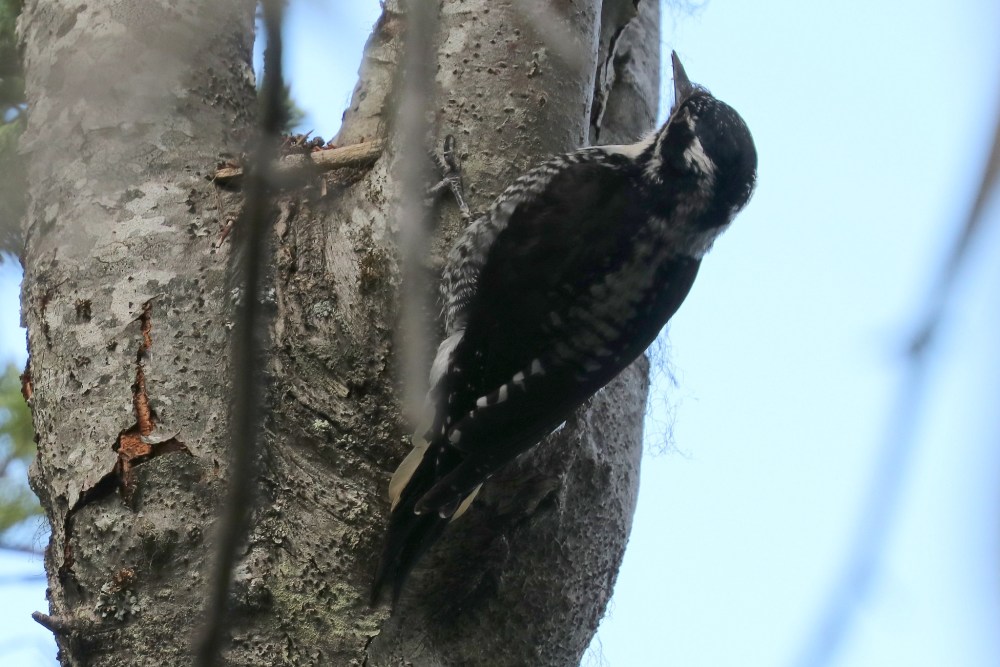
Further on, at the Highway 3 Bridge, we added a Common Loon and Feral (Rock) Pigeons to our master list, officially bringing it up to 97 species for the trip. Although, had we added the Sora and MacGillivray’s Warbler (heard calling), possibly Dusky Flycatcher (Alex didn’t seem sure), and Three-toed Woodpecker seen by many on the return trip at Manning Park (see Addendum by Terry Carr), I think it would be safe to say that this wonderful adventure yielded 100+ species of birds!
A final word on our grand Okanagan Adventure 2022
To say I’m grateful to all who helped to plan this incredible trip away is a grotesque understatement. I think we can all agree that it was a much-needed break, and a reminder of the glorious nature and exciting new birds and wildlife that lie so close to the homes we’ve spent the past two years hunkering down in, waiting for this damn viral apocalypse to abate.
I would like to thank (and thank and thank) Terry Carr for planning the trip in such exquisite detail, and keeping the adventure coming at such an exhilarating rate. Every day was a cornucopia of treasures that unravelled jewel by jewel, and, truly, I think I’ll remember this as one of my life’s favourite trips. Maybe I’m easy to please. Or maybe, just maybe, Terry should quit all other diversions and become a professional bird tour guide. I’ll be a loyal customer.
I’d also like to thank Glen for being Terry’s right-hand man and for arranging, amongst many other things I’m sure, our outing to the winery. I mean, does it get any better than birds and wine? Finally, to all of you who joined: you each added your own colour to the experience, and it was a joy and privilege to spend that time with you and get to know you all better, even if it was to just stand side-by-side with you in awe of nature.
Here’s to the next adventure!

Check out the DNCB flickr site for ALL the wonderful photos taken!
Addendum by Terry Carr:
On the way home, some of us walked around Twenty-minute Lake in Manning Park – just before Lightning Lake – where we looked for and found the Three-toed Woodpecker.

 Delta Naturalists Society
Leave a comment