
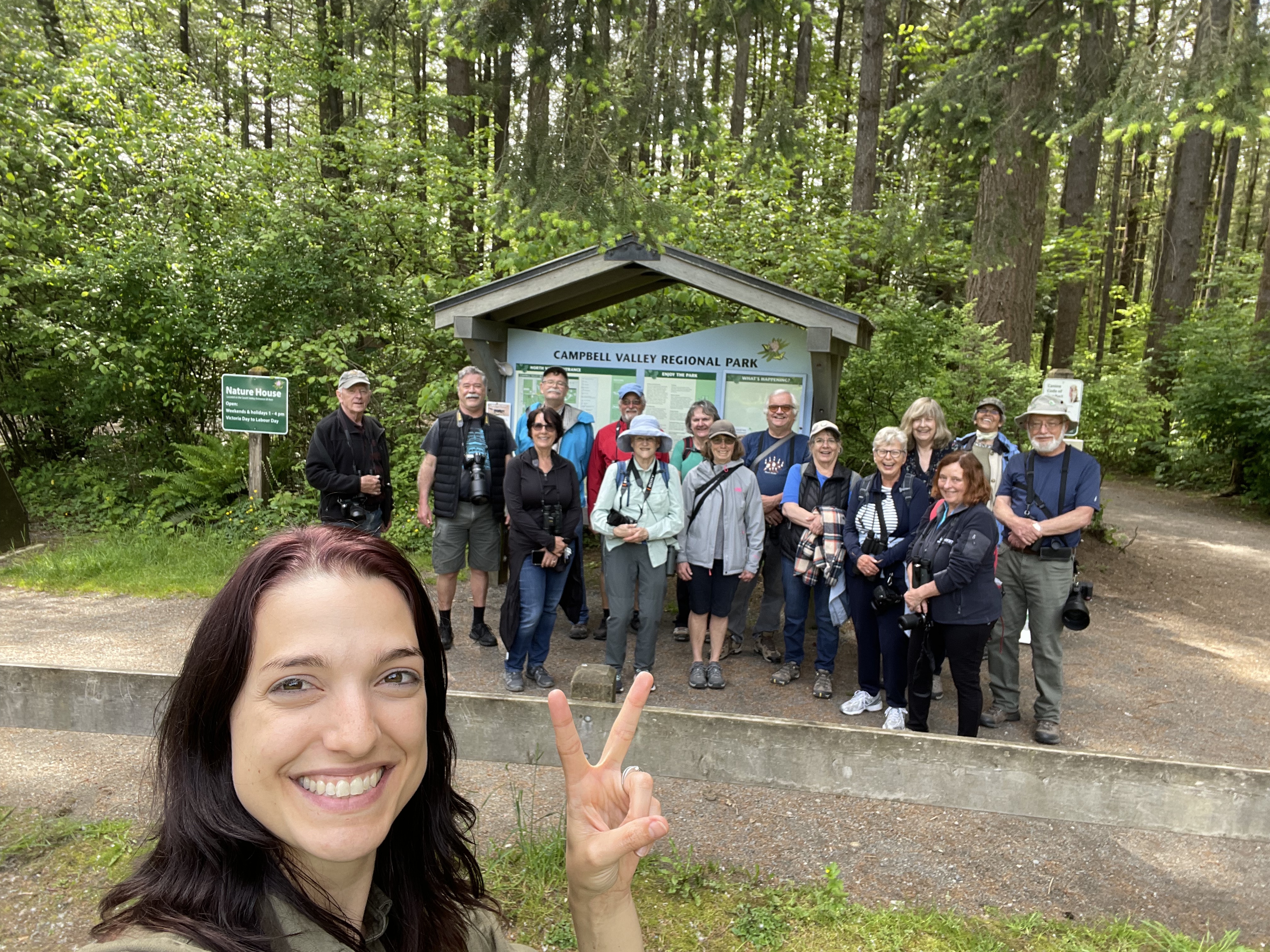
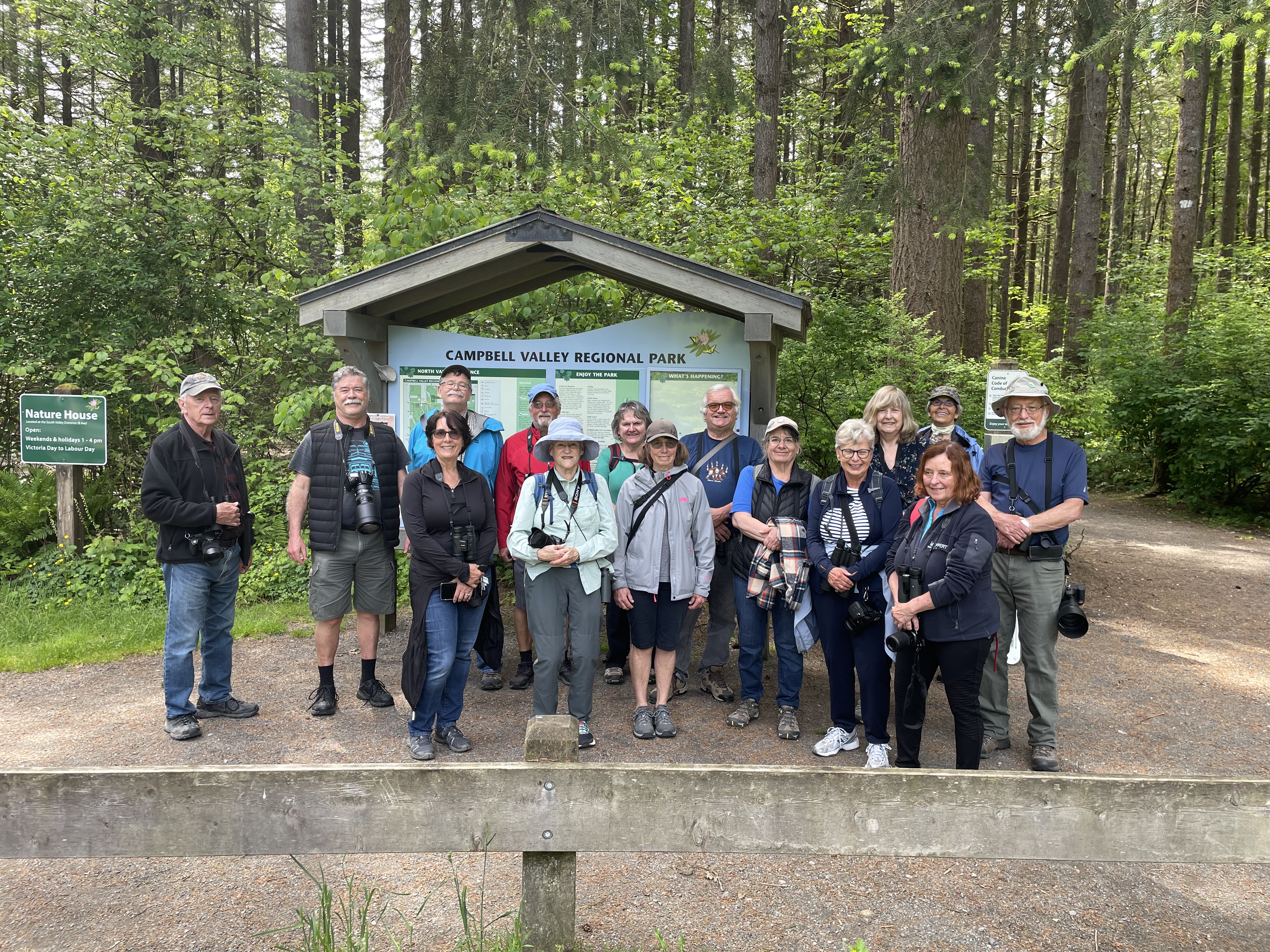
On what has felt like the warmest day of the year, at a positively sweltering 21°C, an impressive 16 DNCB members met in the northern parking lot of the Campbell Valley Regional Park: Brian, Louise, Colin, Stephanie, Margaretha, Gabriele, Marion, Jim, Glen, Chris, Warren, Lynne, Nicki, Rayme, Rosemary, and yours truly, The Keeper Of The List.
Right away, Swainson’s Thrushes made their presence known, loudly piping away their
ascending, trilly songs. Dark-eyed Juncos pecked about at the bases of the bushes embracing the car park, and Song Sparrows were both abundantly seen and heard.
As soon as everybody was present and accounted for, we struck into the forest, sky-scraping Douglas Firs, Big-leaf Maples, and Western Red Cedars rearing up to enormous heights around us. Lower down, weak sunlight filtered through a secondary canopy of young Vine Maples, casting a delicious viridescent glow. The initial section of path yielded hits for Swainson’s Thrush and Wilson’s Warblers, which called loudly from the foliage. A young Dark-eyed Junco of the Slate Colored tribe confused the heck out of us for a second because of its unusual brown plumage and streaky breast (Merlin ID cleared that up for us tout de suite).
Soon thereafter, the forest fell away and we arrived at the Campbell River, a not-quite-majestic torrent of barely-perceptibly flowing water with lush reed beds on either side. A female Mallard with 9 downy chicks paddled about in an open section of water right beneath the boardwalk. Further afield, a Common Yellowthroat disturbed the reeds, flew off and then landed, treating us to a brief glimpse before dipping down again.
Then, back in the thick of the woods, it seems we took the park’s resident Black-capped and Chestnut-backed Chickadees for a walk. The tame little birds are clearly accustomed to being hand-fed, and followed us very closely as we slowly progressed along the path: we searching the emerald understory for movements, them searching our hands for seeds. I know it’s awfully droll of me to find wildlife “cute” but MAN these little chickadees are adorable!
We saw our first Black-headed Grosbeak within 30 minutes of departure … and then KEPT
seeing them as every curve in the path revealed yet more individuals: gorgeous blood-orange males singing their hearts out or tan-colored females, and both with beaks that look like they could crack a squirrel’s skull.
A lone grosbeak-sized bird perched atop a bare, skyward-thrust branch silhouetted against a hazy white sky, making identification difficult … but based on its uniform dusty brown color (visible when it flew off), size, and bill shape, I’m fairly confident it was a female Brown-headed Cowbird. There were lots of Spotted Towhees, American Robins, and (yay!) Yellow Warblers about: rich gold knobs of butter with butterscotch streaks on their breasts.
A Turkey Vulture soared at great height, a little wobbly in flight and with tiny pink head tucked deep between its shoulders (this always helps me to tell the difference between them and Bald Eagles: their heads aren’t visible in silhouette like eagles’ are). The territorial chattering of Douglas Squirrels had me adding Downy Woodpecker to the list only to discover that I was mistaken. It’s quite remarkable how similar they sound!
Speaking of sound … it’s amazing that whatever force designed the little Empidonax flycatchers had the good grace to give them remarkably different calls; otherwise, flycatcher identification would be an Olympic-level sport. But thankfully, because they were so vocal today, we were able to hear and see a Willow Flycatcher (“wheet-wheeo!”) hunting from the topmost branches of shrubs in the open area beyond the woodlands; and a Pacific-slope Flycatcher (“peet-petwee-pipit”)—playing hide-and-seek deep in the boughs of a Douglas Fir.
At the end of one section of boardwalk was a neat little “look out”—though it didn’t look out over much but dense shrubbery. Conveniently, the platform was lined with benches. Even more conveniently, a Steller’s Jay sat and sunbathed for a good long while, and so we were able to sit, rest our legs, and swoon over its azure and black formal wear. Seed that had been put out (thanks, Marion!) attracted both species of squirrels (Douglas and garden-variety), as well as female Grosbeaks. A Rufous Hummingbird flitted about briefly, but no sooner had I called attention to it than it zipped behind a bush, making me look like a chump.
Nearing the end of our walk, the sweet warbling of the aptly named Warbling Vireo attracted our attention to an individual flitting about a bush. The explosive trilling of an Orange-crowned Warbler reminded us that, “Hey, we’re still here!” even though Yellow Warblers stole the show today. And we spotted a Cooper’s Hawk, which caught my attention as it sailed in to land on the uppermost bough of a tall fir, hanging around for long enough for everyone to have a gander.
Some other birds heard and seen include Anna’s Hummingbird, American Goldfinch, Cedar Waxwings—which look like gorgeous painted geishas to me—and Purple Finches, whose liquid trilling seduces the ear but which remains ever-hidden from sight. Teases.
Air Traffic Report: American Bald Eagle and Turkey Vulture. No crows (for once) or gulls,
bringing the outing’s tally to 27 species, which is pretty darned good for notoriously tricky
forest birding!
Thea Beckman
Photos on Flickr
Thea’s eBird list
 Delta Naturalists Society
Leave a comment